

How long does teeth whitening last: Tips to extend your bright smile
This is one of the most common questions I get asked: "How long will my teeth whitening results actually last?" The honest answer is, it really depends. Think of it less like a permanent fix and more like a reset button for your smile. Your results can hold up for just a few months or even last for up to a few years.
What makes the biggest difference? Two things: the whitening method you choose and your everyday habits.
How Long Different Teeth Whitening Methods Last
Let's use an analogy. You can give your car a quick wash in the driveway, and it looks great for a day or two. Or, you can take it to a professional detailer for a deep clean and polish that lasts for months. Teeth whitening works in a very similar way—some methods offer a quick, temporary lift, while others provide a much deeper, longer-lasting brightness.
While no whitening is forever, the good news is you have a lot of control. Your daily coffee, that glass of red wine, and how well you brush and floss all play a huge role in keeping your smile bright.
Comparing The Main Whitening Options
So, what can you realistically expect from the most popular whitening methods out there? Professional treatments, not surprisingly, give you the most bang for your buck in terms of staying power. Over-the-counter products, on the other hand, are better for a shorter-term boost.
This chart gives you a quick visual snapshot of the timelines we're talking about.

As you can see, there’s a direct link between how intensive the treatment is and how long you get to enjoy the results. It’s a classic trade-off between cost, convenience, and durability.
The Bottom Line: The more powerful and controlled the whitening agent is—which you'll find in a professional dental setting—the longer your bright smile is likely to last. From there, it's all about your lifestyle.
If you're curious about ways to keep your teeth bright between treatments, you might find some useful tips in our guide on how to whiten teeth naturally.
Teeth Whitening Longevity At A Glance
To make it even clearer, I've put together this simple table. It's a quick reference guide to help you match your goals—whether you need a fast touch-up or a major transformation—with the right whitening method.
| Whitening Method | Average Duration | Best For |
|---|---|---|
| Professional In-Office | 1 to 3 years | Getting dramatic, fast, and long-lasting results with supervision. |
| Dentist At-Home Kits | 6 to 12 months | Professional-grade results with the flexibility of at-home use. |
| Whitening Strips | 1 to 3 months | An affordable, quick boost for mild stains or a special event. |
| Whitening Toothpaste | Ongoing Maintenance | Gently lifting daily surface stains, not for deep whitening. |
This table really highlights the different roles each product plays. Whitening toothpaste is your daily defender against new stains, while a professional treatment is your heavy-hitter for a major colour shift.
The Power Of Professional In-Office Whitening
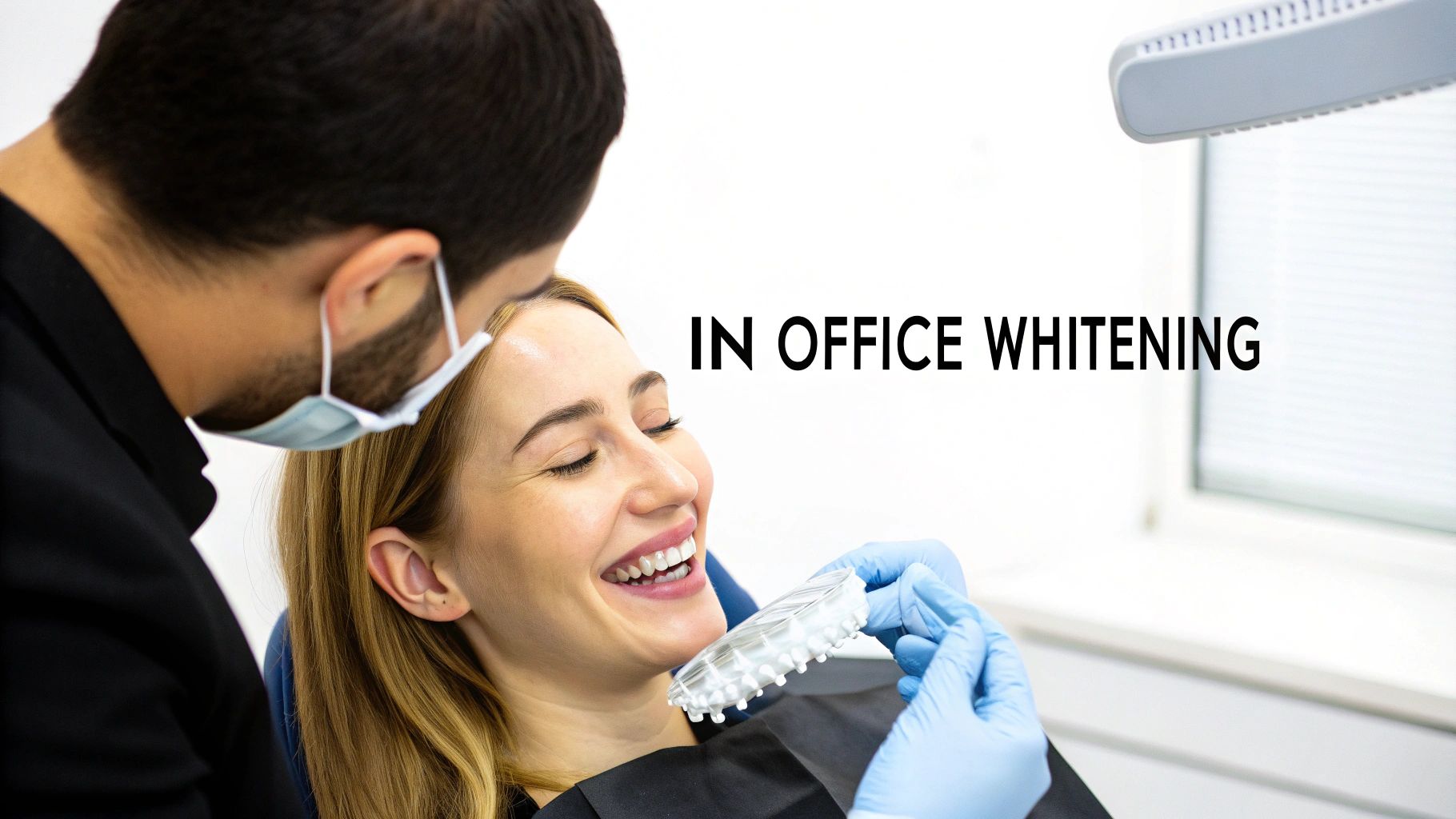 When you're after the most dramatic and immediate smile transformation, nothing really comes close to a professional in-office whitening session. This is the top-tier option, delivering a smile that’s several shades brighter in about an hour.
Think of it like getting your car professionally detailed instead of just hosing it down in the driveway. While a home wash helps, the specialised tools and high-strength products used by a pro deliver a result that’s in a completely different league. The same idea applies to your teeth.
What Makes The Results Last So Long?
The secret to why professional whitening lasts so much longer lies in the sheer power and precise application of the whitening agent. Dentists have access to high-grade hydrogen peroxide or carbamide peroxide gels that are far more concentrated than anything you can buy over the counter.
To do this safely, your dentist first carefully protects your gums and soft tissues with a special barrier. Only then is the potent whitening gel meticulously painted directly onto your teeth. In many cases, a special light or laser is used to activate the gel, speeding up the chemical reaction that breaks down deep, stubborn stains inside the tooth enamel.
This is a controlled, high-impact process. You’re not just scrubbing off surface stains from your last coffee; you’re lifting years of discolouration from deep within the tooth’s structure.
Setting Realistic Expectations For Durability
So, just how long does teeth whitening last after you’ve left the dental chair? The results can be impressively long-lasting, typically ranging from six months up to three years. That’s a big window, and where you land on that spectrum comes down to your daily habits.
For a detailed breakdown of what the initial investment looks like, have a look at our guide on https://www.mytransformation.com.au/blogs/news/teeth-whitening-perth-prices.
The Process and What To Expect
Knowing what happens during the appointment helps you understand why the results are so robust. A typical session follows a few key steps to ensure you get the best and safest outcome.
- Preparation and Protection: First, your dentist will clean your teeth and place a protective shield over your gums and lips. This is a critical step to prevent any irritation from the powerful whitening agent.
- Gel Application: The concentrated whitening gel is then carefully painted onto each tooth, making sure the coverage is complete and even.
- Activation: Often, a special blue light is aimed at your teeth for about 15-20 minutes at a time. This light kicks the peroxide into high gear, dramatically speeding up the stain-lifting process.
- Rinse and Reveal: After the final round, the gel is rinsed off, and you get to see your brilliantly whiter smile.
The entire process is meticulously managed by a dental professional to deliver a brilliant outcome while prioritising your safety. It is this expert oversight that truly sets it apart from any at-home alternative.
This controlled environment allows for a much more potent treatment than you could ever safely do yourself. For those who want to dig a bit deeper, you can learn more about what professional teeth whitening entails and see why a dentist-led approach is so effective. It’s this combination of powerful ingredients and professional application that makes in-office whitening the gold standard for lasting results.
Navigating At-Home Whitening Kits and Their Durability
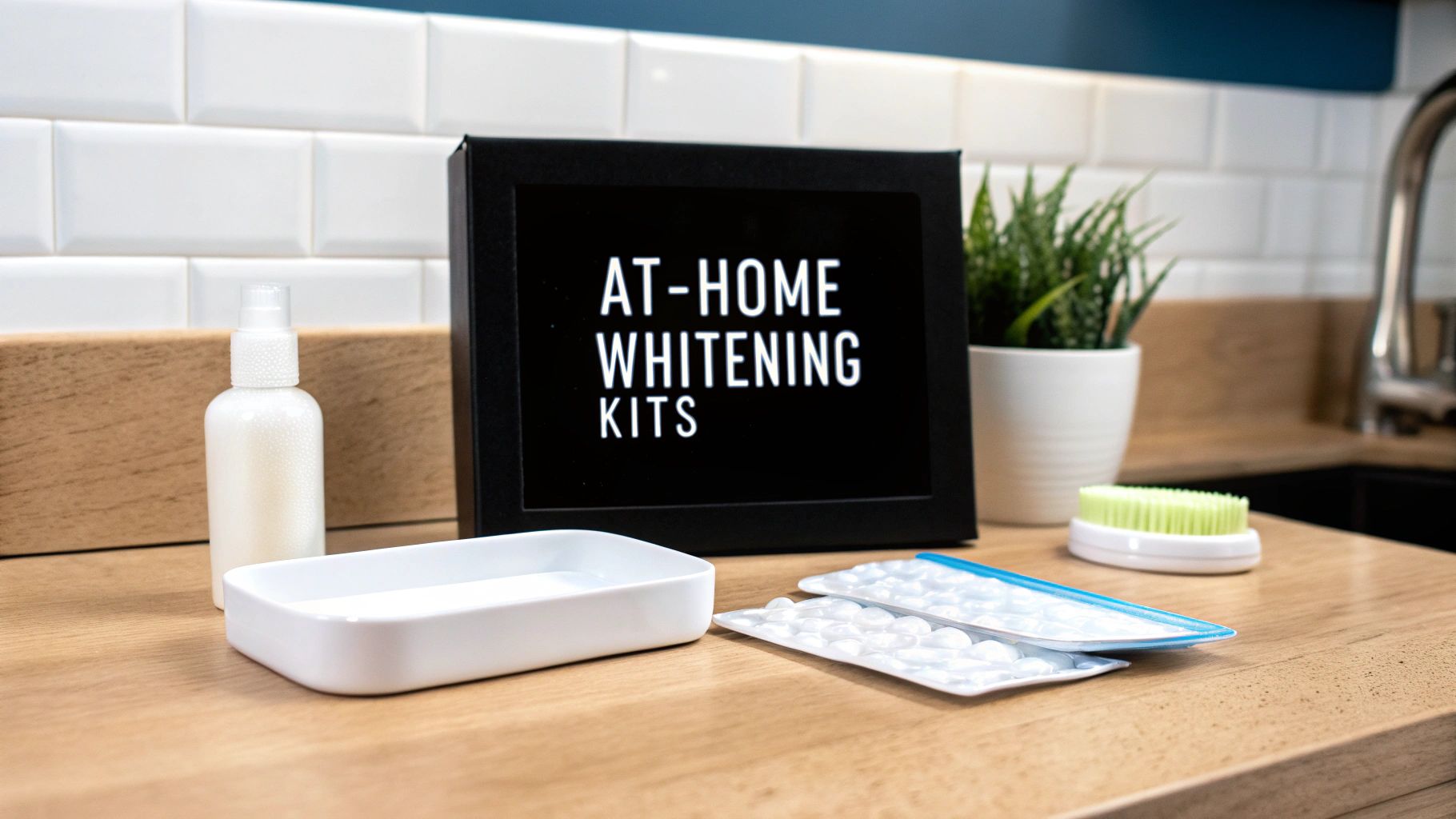 For many of us, the idea of whitening our teeth on our own schedule is a huge plus. At-home kits can strike a brilliant balance between getting great results and being affordable, all from the comfort of your own home.
But it’s important to know that not all at-home kits are the same. They generally fall into two camps: professional take-home systems you get from your dentist, and the over-the-counter (OTC) products you can grab at the chemist. Knowing the difference is crucial for setting realistic expectations for how long your brighter smile will actually last.
The Professional Edge at Home: Dentist-Prescribed Kits
Think of a dentist-prescribed kit as the best of both worlds—it combines the power of professional treatments with the convenience of doing it yourself. These aren't your typical one-size-fits-all products. The whole process starts with your dentist taking a precise mould of your teeth to create custom-fitted whitening trays.
That customisation is their secret weapon. The trays hug your teeth perfectly, ensuring the professional-strength whitening gel gets even, consistent contact with every nook and cranny. This smart design stops the gel from oozing onto your gums (which can cause irritation) and makes sure no spots are missed.
Because these kits use a much stronger, dental-grade whitening agent than you'll find in OTC options, the results are not only more dramatic but also longer-lasting. With a professional take-home kit, you can generally expect your results to last anywhere from 3 to 6 months. Some people even manage to stretch it to a full year with diligent care. This is a significant step up from over-the-counter products, which typically fade after only 1-3 months.
Over-the-Counter Whitening Strips
Whitening strips are probably the most well-known and accessible at-home option. They're dead simple to use and can definitely give your smile a noticeable boost, making them a great choice for a quick touch-up before a special event.
These are just thin, flexible plastic strips coated in a low-concentration peroxide gel. You stick them on your teeth for about 30 minutes a day, usually for a week or two.
While they’re effective for lifting surface-level stains, the results are more temporary than professional methods. The lower peroxide level just doesn't penetrate the tooth enamel as deeply.
On average, you can expect the brightness from whitening strips to last for about one to three months. How long they last really comes down to your diet and lifestyle choices after you finish the treatment.
If you’re thinking about going this route, it pays to do a little research first. You can find some great comparisons and reviews in our guide to the best at-home teeth whitening products to help you pick one that suits your goals and budget.
The Role of Whitening Toothpastes and Mouthwashes
Finally, let's talk about whitening toothpastes and mouthwashes. It's really important to understand what they're designed for: they are maintenance tools, not deep whitening solutions.
Think of them like a regular car wash. They’re fantastic for keeping the surface clean and stopping new dirt from building up, but they aren't going to fix a deep scratch or a faded paint job.
Here’s a quick look at how they work:
- Mild Abrasives: Most whitening toothpastes contain gentle polishing agents that physically scrub away new surface stains from your daily coffee, tea, or food.
- Chemical Agents: Some also include very low levels of whitening agents like hydrogen peroxide to help lift extrinsic (surface) stains.
These products are your best friend for maintaining the results from a stronger whitening treatment, but they won't create a dramatic, long-lasting shade change on their own. Their effect is really only present for as long as you keep using them.
Ultimately, choosing the right at-home method depends on what you want to achieve. For a significant, more durable change, a dentist-prescribed kit is the clear winner. For a temporary and affordable boost, whitening strips are a solid option. And for daily upkeep to keep new stains at bay, a good whitening toothpaste is the way to go.
Key Factors That Impact Your Whitening Results
Ever wondered why your friend’s teeth whitening seems to last forever, while yours fades after just a few months? It’s not just about the whitening method you chose. A handful of key factors, some in your control and some not, really dictate how long you get to enjoy that brilliant new smile.
Think of your freshly whitened teeth like a new white t-shirt. Right out of the packet, it’s crisp and bright. But what happens next is all about how you look after it.
Spill some coffee or red wine, and you’ll get an instant stain. It’s the exact same principle for your tooth enamel. Getting your head around these influences is the first step to protecting your investment and keeping your smile looking its best for as long as possible.
Your Diet: The Biggest Staining Culprit
By far the biggest factor in how long your whitening lasts is what you eat and drink. Your tooth enamel isn’t a solid, impenetrable surface; it’s porous, with microscopic pits and ridges that can soak up pigments from your food and drinks. That’s how stains set in over time.
For the first 48 hours after whitening, your teeth are especially vulnerable to picking up new stains. But really, it's your long-term habits that will make or break your results.
Some of the worst offenders for discolouration include:
- Dark Drinks: Coffee, black tea, red wine, and colas are full of dark pigments called chromogens, which just love to latch onto tooth enamel.
- Vibrant Fruits and Veggies: While they’re great for you, richly coloured foods like blueberries, blackberries, cherries, and beetroot can leave their mark.
- Rich Sauces: Things like soy sauce, balsamic vinegar, and tomato-based sauces also contain powerful pigments that can dull down your smile.
This doesn't mean you need to give up your favourite foods for good. It’s just about being a bit more mindful. A quick rinse with water after your coffee or meal can make a world of difference in stopping new stains from taking hold.
Lifestyle Choices: Smoking And Oral Hygiene
Beyond what’s on your plate, a few lifestyle habits play a huge part in how long your teeth stay white. Smoking is probably the fastest way to undo all the good work of a whitening treatment. The tar and nicotine in tobacco create stubborn yellow and brown stains that are a real pain to get rid of.
Your daily oral hygiene routine is your number one line of defence. Brushing twice a day and flossing daily clears away plaque, which is the sticky film where stain-causing particles build up. If you let that slide, stains will quickly creep back and dim the brightness you worked so hard for.
A consistent and thorough oral hygiene routine is non-negotiable for preserving your whitening results. It’s the foundation upon which all other maintenance efforts are built.
Factors You Cannot Control: Enamel and Age
While you can manage your diet and daily habits, some things are just part of your unique dental makeup. The natural thickness and smoothness of your tooth enamel, for instance, can affect how easily your teeth stain. Thinner enamel can sometimes allow the yellowish layer of dentin underneath to show through more clearly.
Age also plays a role. As we get older, our enamel naturally thins out, and our teeth can collect more deep-set stains over a lifetime. It’s a normal part of the ageing process, but it does affect how well your teeth respond to whitening and hold their colour. Knowing this helps set realistic expectations for your results.
These factors can also influence whether you experience sensitivity. If that's a concern, it's a good idea to read up on potential teeth whitening side effects to be fully prepared.
The Starting Shade Of Your Teeth
Finally, where you start from has a big impact on where you end up and how long it lasts. Teeth with a natural yellow tone tend to whiten up beautifully and often keep their brightness for longer.
On the other hand, teeth that have a greyish or brownish tinge—sometimes caused by old medications or an injury—are often more stubborn. You can still see a great improvement, but the results might not have the same staying power as they would for someone with naturally yellower teeth. Knowing your starting point helps you and your dental professional map out a realistic and effective plan.
How to Make Your Teeth Whitening Results Last Longer

Getting your teeth professionally whitened is a fantastic feeling, but the work doesn't stop when you leave the dentist's chair. Achieving that brilliant smile is only half the journey; the real secret is what you do next.
Think of it like getting a new paint job on a classic car. You wouldn't immediately drive it down a dusty, muddy road. Your post-whitening routine is all about protecting that fresh, clean surface so you can enjoy it for as long as possible. This is your game plan for keeping that smile bright for months, or even years.
Your Post-Whitening Checklist: The First 48 Hours
Right after a whitening treatment, your tooth enamel becomes temporarily porous. This means your teeth are like tiny sponges, incredibly quick to soak up any colours they come into contact with. That makes the first 48 hours the most critical period for locking in your results.
The key is to follow a "white diet." If it could stain a white t-shirt, it can definitely stain your teeth.
Here’s a quick list of what to sidestep for a couple of days:
- Dark Drinks: Coffee, black tea, red wine, and soft drinks are the main culprits.
- Colourful Foods: Steer clear of things like berries, beetroot, soy sauce, and rich tomato sauces.
- Tobacco: Smoking or chewing tobacco is one of the fastest ways to undo all that good work. It’s best to avoid it completely.
Instead, stick to simple, light-coloured foods. Think chicken, fish, rice, pasta, and water. It might feel a bit restrictive, but this short-term effort pays off massively in the long run.
Building Smart, Long-Term Habits
Once you’ve cleared that initial 48-hour window, you can start bringing your favourite foods and drinks back into the mix. You don't have to give up your morning coffee forever, but you do need to be a bit more strategic.
One of the simplest tricks in the book is to use a straw for staining drinks like iced coffee or tea. It helps the liquid bypass the front surfaces of your teeth, which are the most visible. Problem solved.
Another great habit is to simply rinse your mouth with water right after you've had something colourful to eat or drink. A quick swish washes away most of the staining compounds before they have time to settle in. For more great ideas, check out these practical tips for keeping your teeth white after bleaching.
The Role of Maintenance Products and Cleanings
Your daily oral hygiene is your first line of defence. Brushing twice a day with a good whitening toothpaste helps gently polish away any new surface stains before they can become permanent. And don't forget to floss—stains love to creep into the spaces between your teeth where plaque builds up.
On top of your home routine, regular professional cleanings are non-negotiable. Your hygienist can remove the tough plaque and tartar that your brush just can't handle, keeping your smile looking its absolute best.
If you struggle with sensitivity, finding the right products is crucial. You can explore some excellent choices in our guide to teeth whitening for sensitive teeth that help you maintain your shade without any discomfort.
When to Consider Top-Up Treatments
Let's be realistic: no teeth whitening is permanent. Life happens, and your teeth will naturally start to pick up stains again over time. That’s perfectly normal. The trick is to stay ahead of the game with occasional top-up treatments.
How often you'll need a touch-up really depends on the method you used and your daily habits.
- After Professional In-Office Whitening: A touch-up every 12 to 24 months is usually plenty to keep things looking bright.
- After Using a Dentist At-Home Kit: A quick top-up for a night or two every 4 to 6 months is often all it takes to maintain that perfect shade.
These follow-up sessions are much quicker and less intense than your initial treatment. Think of them as a quick refresh to lift away any recent discolouration and get your smile back to its peak brightness.
Got Questions About How Long Whitening Lasts?
Even with all this information, you probably still have a few questions rolling around in your head. That's completely normal. Let's clear up some of the most common queries we get so you can feel totally confident moving forward.
Think of this as our final chat to iron out any last-minute uncertainties. We'll tackle the big questions head-on with straight, simple answers.
Is Teeth Whitening Permanent?
The short answer is no, teeth whitening isn't a one-and-done permanent fix. A good way to think about it is like getting your hair coloured—it looks incredible at first, but it needs a bit of upkeep to stay that way. The surfaces of your teeth are porous, which means they naturally absorb stains from things like coffee, tea, and red wine over time.
Because of this, your bright new smile will gradually start to fade if you don't do anything to maintain it. How long your results stick around really comes down to your lifestyle habits and aftercare routine. Think of periodic top-up treatments as the secret to keeping that brilliant shade you worked so hard for.
Can I Whiten Crowns Or Veneers?
This is a really important one to get right. Whitening gels only work on natural tooth enamel. They have zero effect on the colour of dental work like crowns, veneers, bridges, or fillings. The colour of these restorations is set in stone when they're made to match your teeth at that specific moment.
If you go ahead and whiten the natural teeth around them, you could end up with a noticeable mismatch. Your crowns or veneers might suddenly look dull or yellow in comparison. It's crucial to chat with your dentist before starting any whitening if you have existing dental work; they can help you come up with a plan for a seamless, natural-looking smile.
A Quick Heads-Up: Always let your dentist know you're thinking about whitening if you have crowns, veneers, or fillings. They'll guide you on how to avoid an uneven result so your entire smile looks fantastic.
Does Teeth Whitening Damage Enamel?
When it's done the right way—either by a dental professional or using a dentist-approved product exactly as instructed—teeth whitening is perfectly safe and won't harm your enamel. The active ingredients, typically hydrogen peroxide or carbamide peroxide, have been studied for years and are proven to be safe and effective.
The most common thing people experience is a bit of temporary sensitivity, which usually settles down a day or two after treatment. The real risk comes from overusing whitening products, doing it too often, or using unverified methods, which can irritate your teeth and gums. Sticking to professional advice is your best bet for a safe and stunning outcome.
How Often Can I Whiten My Teeth?
There's no single answer here—how often you should whiten really depends on the method you're using and what your teeth need. Trying to whiten too often is a fast track to problems.
- Professional In-Office Treatment: You might only need to come in for a full session once every one to three years.
- Dentist-Prescribed Take-Home Kits: A quick top-up for a night or two every four to six months is usually all it takes to keep your smile looking its best.
Remember, the aim is to maintain your results, not to keep pushing for a whiter and whiter shade. Over-whitening can cause serious sensitivity and can even make your teeth look unnaturally translucent. Your dentist is the best person to create a safe and effective schedule that's customised for you.
At My Transformation, we're dedicated to helping you achieve the confident look you deserve, whether it's through our advanced teeth whitening services or our specialised hair loss solutions. Learn more about how we can help you transform your smile and confidence today!