
Why Is My Hair Falling Out? Causes, Remedies, and Next Steps
It’s a moment that can stop you in your tracks: seeing a startling amount of hair in the shower drain or left behind on your hairbrush. If this sounds familiar, you're not alone. It's an incredibly common experience for countless Australians.
But here’s the thing: hair loss isn’t a single, straightforward problem. It's more of a symptom, a sign that something else is going on—and the triggers can range from your genetics to your stress levels. Understanding what's normal and what's not is the first, most crucial step toward getting things back on track.
Decoding Why Your Hair Is Suddenly Falling Out
To get to the bottom of hair loss, it helps to first understand how hair actually grows. Think of your scalp as a garden, where each hair follicle is a tiny seed, sprouting and growing through a predictable cycle. Most of the time, this cycle runs smoothly in the background.
But sometimes, that cycle gets thrown off balance.
Every hair on your head goes through a three-phase journey: growing, transitioning, and finally, resting before it sheds. On a normal day, it’s perfectly natural to lose between 50 and 100 hairs. When certain triggers interfere, however, a large number of follicles can get pushed into the shedding phase all at once, which is when you start to notice thinning.
If you want to dive deeper, we break down the whole process in our detailed guide to the hair growth cycle.
Common Triggers Behind Hair Loss
So, what are these triggers? Pinpointing the exact cause is everything, because the "why" determines the "what's next." The main culprits usually fall into one of a few key categories.
This diagram gives a great overview of the different pathways that can lead to hair loss.
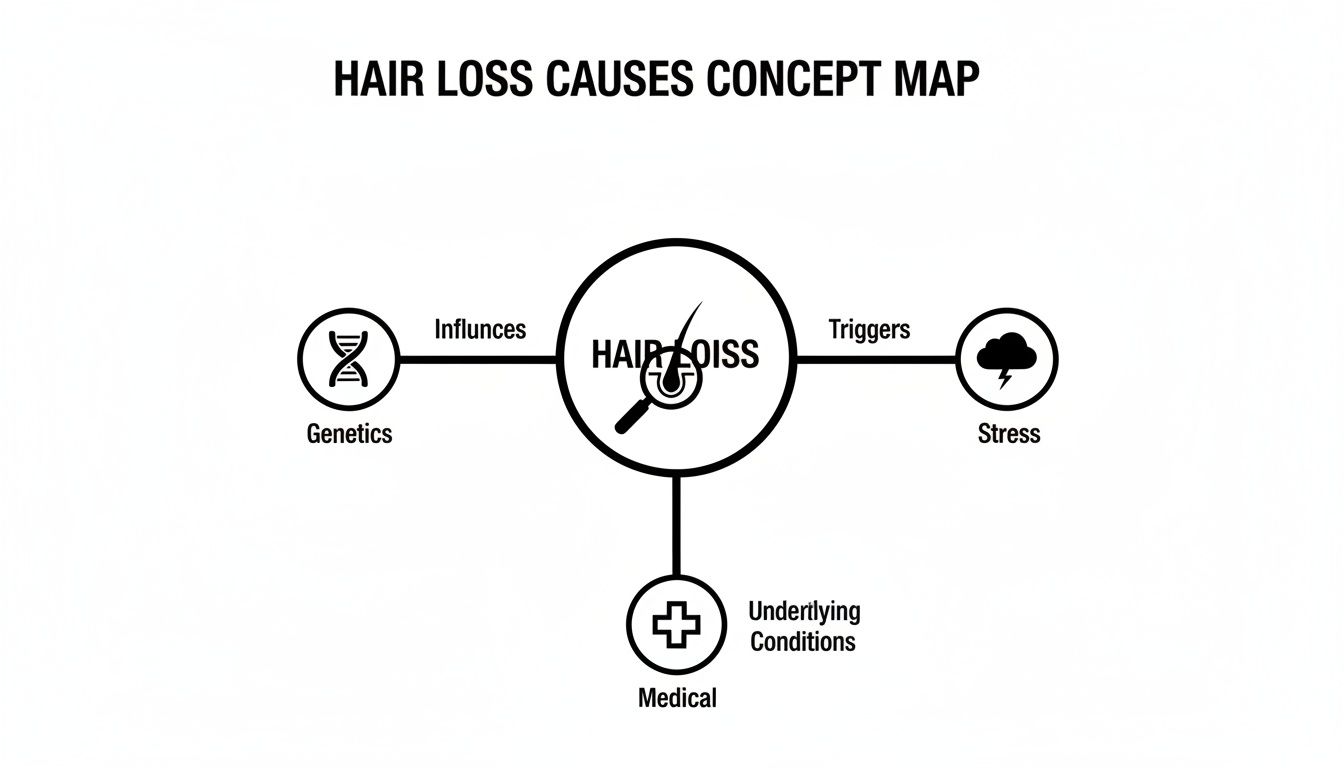
As you can see, figuring out what's going on starts with looking at three core areas: your genetics, your stress levels, and your overall health. Each one of these branches leads to different types of hair loss, with unique signs and solutions.
Your Personal Hair Loss Roadmap
To figure out what’s happening with your own hair, you need to know what to look for. Different causes show up in different ways. Recognising the specific signs is your first real step toward taking back control.
In this guide, we’ll walk you through the most common reasons you might be asking, "Why is my hair falling out?"
Here’s a sneak peek at what we'll cover:
- Genetics: This is all about hereditary conditions like male and female pattern baldness—things that are literally written into your DNA.
- Stress & Lifestyle: We'll explore how major physical or emotional stress can trigger a sudden, and often dramatic, period of shedding.
- Medical Conditions: This covers a wide range, from autoimmune disorders and hormonal shifts to nutritional deficiencies that can essentially starve your hair follicles.
By the time you're done reading, you won't just have information—you'll have a clear plan. You'll have a much better idea of what might be causing your hair loss, know the specific signs to watch for, and feel ready to explore the right solutions for you.
The Role of Genetics in Hair Loss
If you’ve started to notice your hairline creeping back or the hair on your crown looking a bit thin, there’s a good chance the reason is written in your DNA. This is Androgenetic Alopecia, but you probably know it better as male or female pattern baldness. It’s far and away the most common answer to the question, "why is my hair falling out?"
Think of your genes as the blueprint you inherit from your family. For millions of us, that blueprint includes specific instructions that make our hair follicles extra sensitive to certain hormones. This isn't a defect or a flaw; it's just a very common (and often frustrating) genetic trait.
This sensitivity triggers a slow-motion process called miniaturisation. Over many years, your healthy, thick hairs are gradually replaced by ones that are finer, shorter, and weaker, until eventually, those follicles just give up and stop producing hair altogether.
Unpacking the Hormonal Trigger: DHT
The main player in this genetic story is a hormone called Dihydrotestosterone, or DHT. It’s a natural byproduct of testosterone that everyone has, men and women alike. The problem isn’t the hormone itself, but how your follicles react to it. If you’re genetically predisposed to hair loss, DHT is the culprit that sets everything in motion.
Here’s an easy way to think about it: Imagine your hair follicle is a lock, and DHT is the key. For most people, the key doesn't quite fit. But if you have the genes for pattern baldness, DHT is the perfect key. It slides in, turns the lock, and signals the follicle to start shrinking.
Hormones are the conductors of your hair growth orchestra. When there's an imbalance or a genetic sensitivity—especially to DHT—the whole rhythm gets thrown off. This is the core reason behind most cases of pattern baldness.
For a deeper dive into the science, check out our in-depth guide on what causes male pattern baldness.
How Pattern Hair Loss Presents Differently
While the root cause is the same, androgenetic alopecia doesn't look the same on everyone. Spotting the classic signs for your gender is the first step toward getting a handle on it.
This table gives a quick comparison of how genetic hair loss typically appears in men versus women.
| Feature | Male Pattern Baldness (MPB) | Female Pattern Hair Loss (FPHL) |
|---|---|---|
| Primary Area | Hairline and crown (vertex) | Top and crown of the scalp (diffuse) |
| Typical Pattern | Receding 'M' shaped hairline, bald spot on top | A widening centre part line |
| Frontal Hairline | Usually recedes significantly | Typically remains intact |
| End Result | Can lead to partial or complete baldness | Rarely leads to total baldness, just overall thinning |
Recognising these distinct patterns is often the clearest sign that genetics are at play.
It's also worth noting that our environment plays a role. Here in Australia, with our famously high UV index, the sun can really accelerate the process. Research has shown that constant sun exposure damages fragile hair follicles and speeds up scalp ageing. For Australian men, where male pattern baldness accounts for over 90% of hair loss cases, our love for the outdoors can unfortunately make things worse over time.
The bottom line? If your hair loss looks like the patterns described above, genetics is almost certainly the main reason. Knowing this helps you cut through the noise and start looking at solutions that are actually designed to tackle this very specific, inherited condition.
How Stress and Lifestyle Can Trigger Sudden Hair Shedding
It’s not just genetics that dictate the health of your hair; our day-to-day lives have a massive say in it too. If you’ve ever gone through a really rough patch and found yourself asking, "why is my hair falling out all of a sudden?", you've likely seen the firsthand effects of stress. This sudden, widespread shedding has a name: Telogen Effluvium.
Imagine your body has a central power grid. Under normal circumstances, it happily sends power everywhere, including to non-essential luxuries like hair growth. But when a major physical or emotional shock hits, your body flicks a switch. It instantly reroutes all available energy to your vital organs to manage the crisis, cutting power to the hair follicles and pushing a huge number of them into the shedding (telogen) phase all at once.
The strange part is the delay. The shock happens now, but the hair doesn't start falling out until about two to three months later. It can be genuinely distressing to see so much hair in the shower drain or on your brush, but it’s actually a sign of your body’s powerful self-preservation instinct kicking in.
What Kicks Off Stress-Induced Shedding?
The "shock" we're talking about isn't your average daily frustration. It’s a significant, system-rattling event that can be either physical or emotional.
For many Australians, these triggers are just a part of modern life.
- Intense Emotional Stress: Things like a messy divorce, losing someone close, or the immense pressure of a high-stakes job in a city like Perth can be more than enough to disrupt your hair's growth cycle.
- Major Physical Trauma: This could be anything from major surgery and serious accidents to recovering from a severe illness like COVID-19.
- Sudden Hormonal Shifts: Postpartum hair loss is a perfect example of Telogen Effluvium. It's triggered by the dramatic hormonal nosedive women experience after giving birth.
- Drastic Dietary Changes: Aggressive crash diets or rapid weight loss can starve your body of the key nutrients it needs to grow hair, shocking the follicles into a dormant state.
The defining feature of this condition is diffuse thinning all over your head. It’s very different from the distinct bald patches of Alopecia Areata or the predictable patterns of genetic hair loss. To get a better grasp on this, you can learn more about how stress causes hair loss in our detailed guide.
The Cortisol Connection
When you’re constantly stressed, your body pumps out the hormone cortisol. In small doses, it's fine. But when cortisol levels are chronically high, it can wreak havoc on your hair, essentially locking follicles in the resting phase for far too long.
This is becoming a serious issue across Australia. In fast-paced cities like Sydney, Melbourne, and Brisbane, the demanding pace of life isn't just a trigger; it's an accelerator for hair loss in both men and women. Elevated cortisol pushes more hair into the shedding phase, and if you already have a genetic tendency for hair loss, this constant stress can make it show up earlier and progress faster.
The good news? Telogen Effluvium is almost always temporary. Once you identify and manage the root cause of the stress, your body’s internal systems reset, and the hair follicles will eventually get back to their normal growth cycle.
This means the best "treatment" isn't a lotion or a pill, but a plan. Getting the source of the stress under control is everything. That might mean making some real lifestyle changes, talking to a professional, or simply giving your body the time and space it needs to heal from a physical trauma. Patience is absolutely key here—it can take several months before the shedding slows down and you start to see new growth.
Exploring Medical Reasons for Hair Loss
Think of your overall health as the soil your hair grows from. Beyond your genes and daily stress, what’s happening inside your body can have a huge impact on your hair. When things are out of balance internally, your hair is often one of the first things to send out a distress signal. If you're asking, "why is my hair falling out?", this is a critical area to look into.
Sometimes, the answer is an underlying medical condition. These issues can throw the delicate hair growth cycle off course, causing thinning or shedding that simply won't stop until the root problem is sorted out. Learning to spot the signs is the first step toward getting the right help.

Alopecia Areata: An Autoimmune Mix-Up
One of the most striking medical causes is Alopecia Areata. Imagine your immune system is your body’s personal security guard, trained to take down foreign invaders. With Alopecia Areata, that guard gets confused and mistakenly tags your own hair follicles as a threat.
The immune system then launches an attack, causing inflammation that effectively shuts down hair production. This leads to sudden, patchy hair loss—often in perfectly smooth, round circles on the scalp, beard, or anywhere on the body. While the condition itself isn't physically harmful, the emotional toll can be significant. You can learn more about finding the right support from a hair specialist for alopecia in our related guide.
What causes this autoimmune reaction isn't fully understood, but it seems to have a genetic link and can sometimes be triggered by severe stress or another illness.
Thyroid Troubles and Hormonal Havoc
Your thyroid gland is basically the control room for your metabolism. It pumps out hormones that regulate everything from your energy levels to, you guessed it, your hair growth cycle. If this gland goes into overdrive (hyperthyroidism) or slows right down (hypothyroidism), it can send your whole system into a spin.
Both conditions are known to cause diffuse hair thinning all over the scalp. You might also notice your hair feels unusually dry and brittle.
Keep an eye out for other tell-tale signs of a thyroid issue:
- Unexplained weight changes: Suddenly gaining or losing weight without changing your diet or exercise routine.
- Fatigue and mood swings: Feeling completely drained, sluggish, anxious, or irritable for no clear reason.
- Changes in skin and nails: Noticing very dry skin or nails that have become brittle and ridged.
If your hair loss comes with any of these symptoms, a simple blood test from your GP can quickly figure out if your thyroid is the culprit.
The Impact of Nutritional Gaps
Your hair follicles are like tiny factories that need a constant supply of raw materials—vitamins and minerals—to churn out strong, healthy hair. If your diet isn't providing these essential nutrients, hair growth is one of the first things your body puts on the back burner to conserve resources.
It’s a bit like trying to build a house without enough bricks and mortar. Sooner or later, construction grinds to a halt. The same goes for your hair.
Iron, zinc, protein, and B vitamins are absolutely vital for healthy hair. A shortfall in any of these can directly lead to more shedding and weaker strands.
Iron deficiency (anaemia) is an especially common cause, particularly for women. It essentially starves the hair follicle of the oxygen it needs to function properly. If you're a vegetarian or vegan, or experience heavy periods, you could be at higher risk. The good news? Hair loss from nutritional gaps is usually reversible once you correct the deficiency with guidance from your doctor.
When Medications and Treatments Are the Cause
Finally, it's worth remembering that certain medications and medical treatments can have hair loss as a known side effect. This type, called anagen effluvium, happens when a drug directly interferes with the active growth phase of the hair cycle.
Common culprits can include some blood thinners, antidepressants, and blood pressure medications. Of course, the most well-known example is chemotherapy. When looking at medical reasons, dealing with chemotherapy hair loss is a major journey for many patients. The shedding is often widespread and fast, but it’s almost always temporary. In most cases, hair starts to grow back once the treatment is over.
Finding the Right Hair Loss Solution
Once you have a clearer idea of what’s driving your hair loss, the natural next step is figuring out what you can actually do about it. The best path forward really depends on the root cause, what you're willing to spend, and the kind of results you’re hoping for. It's less about finding a single magic bullet and more about matching the right strategy to your unique situation.
There are some seriously effective options out there, from proven medical treatments to more advanced clinical procedures. Each one has its own process, requires a different level of commitment, and delivers different potential outcomes. Let's break down the main categories so you can get a handle on your options and make a decision you feel good about.
Proven Medical Treatments
For a lot of people, especially those dealing with genetic hair loss, medical treatments are the first port of call. These are scientifically-backed options, widely used here in Australia, that are designed to either put the brakes on thinning or help kickstart new growth.
They generally come in two forms:
-
Topical Solutions (like Minoxidil): You’ve probably seen this one on the chemist’s shelf. Minoxidil is a liquid or foam that you apply directly to your scalp. It works as a 'vasodilator', which is just a fancy way of saying it widens blood vessels. This boosts blood flow to your hair follicles, bringing in more oxygen and nutrients to hopefully wake up dormant follicles and keep your hair in its growth phase for longer.
-
Oral Medications (like Finasteride): This is a prescription-only pill, mostly for men. It gets right to the hormonal cause of male pattern baldness by blocking the enzyme that turns testosterone into DHT—that follicle-shrinking culprit we talked about earlier. By knocking down the DHT levels in your scalp, it can stop the thinning process in its tracks and sometimes even encourage regrowth.
Just keep in mind, both of these require consistent, long-term use to keep seeing the benefits. And if you're leaning towards more natural remedies, exploring specialised products like rice water shampoo and conditioner bars for hair growth can be a great way to support overall hair health.
Advanced Clinical Procedures
If you’re after more dramatic or permanent results, then clinical procedures offer some powerful alternatives. They're a bigger commitment in terms of time and money, but the payoff can be a real game-changer for your hair density.
Think of clinical procedures as a direct intervention. Instead of just managing the problem with daily medications, you're physically adding or stimulating hair in the thinning areas.
Platelet-Rich Plasma (PRP) Therapy
PRP is pretty clever—it uses your own body's natural healing abilities to get your hair growing again. The process starts with a simple blood draw. That blood is then spun in a centrifuge to isolate the platelet-rich plasma, which is basically liquid gold full of growth factors. This concentrated plasma is then carefully injected back into the thinning areas of your scalp.
The whole idea is that these growth factors give your dormant hair follicles a serious wake-up call and encourage repair at a cellular level. It’s usually done over a series of sessions and can be a fantastic booster when used alongside other treatments.
Hair Transplant Surgery
For a truly permanent fix, a hair transplant is the gold standard. It’s a surgical procedure, but the results speak for themselves. There are two main techniques you’ll hear about:
- Follicular Unit Transplantation (FUT): This involves removing a small strip of skin with healthy hair from the back of your scalp. Technicians then carefully dissect individual follicular units from that strip before they’re transplanted to the bald or thinning spots.
- Follicular Unit Extraction (FUE): With FUE, individual hair follicles are extracted one by one directly from the donor area. It’s a bit like picking the best apples from a tree. These follicles are then implanted where they're needed most.
Both methods are built on the same brilliant principle: moving your own healthy, DHT-resistant hair follicles from the back and sides of your head to the front and top. It’s a major commitment, both financially and in terms of recovery, but it’s also incredibly effective. If you’re feeling a bit overwhelmed by the choices, our guide on how to stop hair loss is a great place to get more clarity.
Scalp Micropigmentation: A Lasting Cosmetic Solution
While medical treatments are busy working behind the scenes to slow hair loss or encourage regrowth, they often test your patience. For anyone looking for an immediate and permanent aesthetic fix, there's another fantastic option on the table: Scalp Micropigmentation (SMP). It’s a brilliant cosmetic procedure that instantly creates the look of a full head of hair.
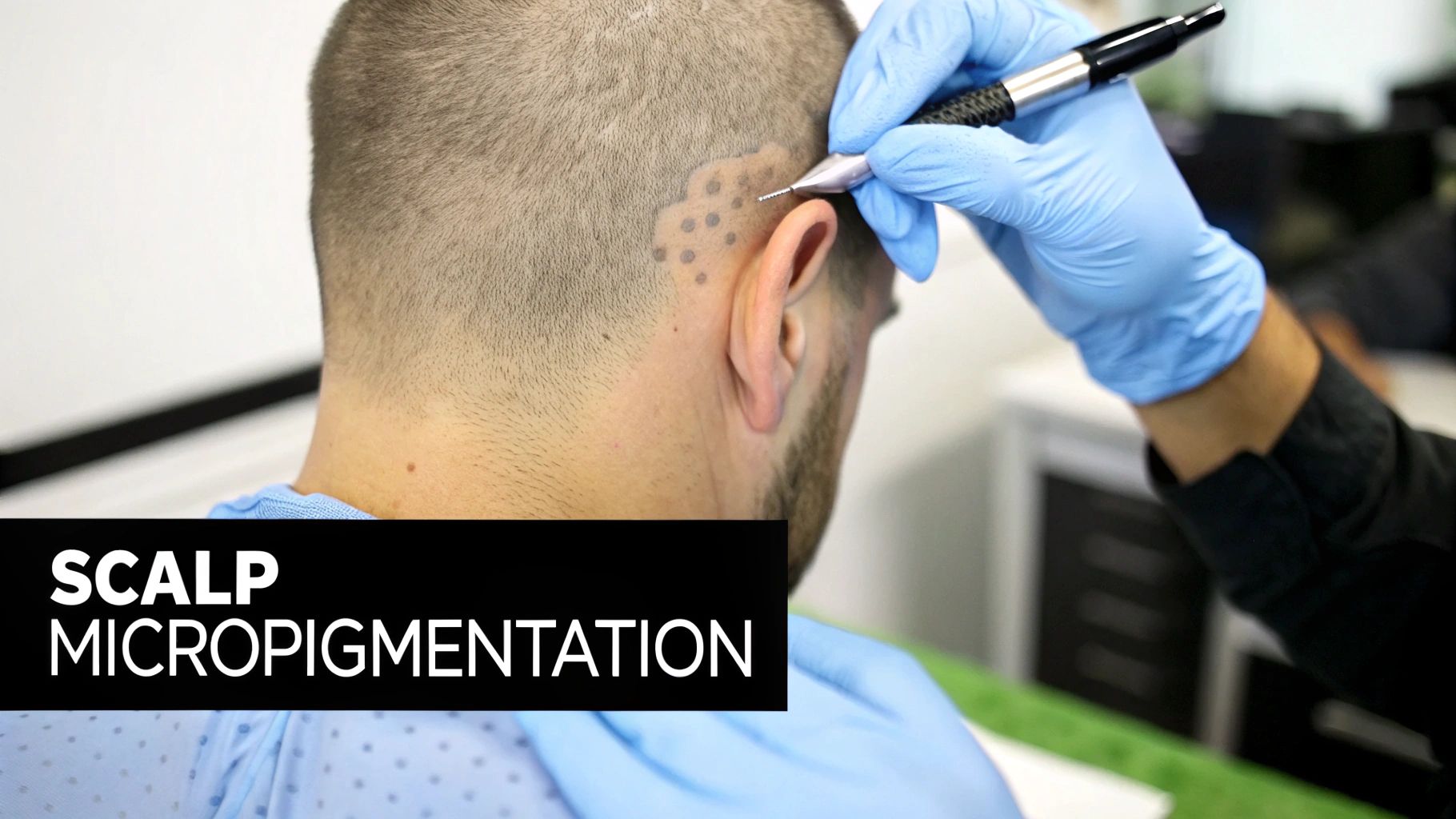
It's really important to get one thing straight: SMP doesn't grow hair back. Instead, think of it as a highly advanced cosmetic tattoo, a form of pointillism for your scalp. A skilled technician uses incredible precision to deposit thousands of tiny pigment dots into the skin.
These micro-dots are layered carefully across the scalp over a few sessions, perfectly matched to your hair colour and skin tone. Each dot is placed to mimic a real hair follicle, which cleverly hides thinning patches or complete baldness. The final look is so realistic it blends seamlessly with any hair you have.
How SMP Creates Such a Natural Look
The magic of SMP is all in the detail. A great technician doesn't just colour in a bald spot. They meticulously design a natural hairline, build up texture, and create density in layers. This painstaking process is why the result is virtually undetectable.
The whole point is to reduce the stark contrast between your scalp and your hair, because that's what makes thinning so obvious.
- For Shaved Heads: SMP gives you that sharp, fresh buzz-cut look, even on a completely bald head. It frames your face and can totally wind back the clock.
- For Thinning Hair: For those with longer hair, SMP works by adding depth. It essentially 'fills in' the scalp beneath the hair, making your existing hair look much thicker and fuller. It's an incredibly popular choice for both men and women.
The real power of Scalp Micropigmentation is its ability to deliver immediate visual results. Clients walk out of their very first session with a noticeable improvement in perceived hair density, offering a significant confidence boost right away.
This technique is also incredibly versatile. It works for just about every type of hair loss, from male pattern baldness and thinning crowns to receding hairlines. It can even be used to camouflage scars, including those from old hair transplant surgeries.
The Key Advantages of SMP
When you're weighing up all the ways to tackle hair loss, SMP brings a unique set of benefits to the conversation. It’s a reliable, non-invasive way to take back control of your appearance.
Here’s why so many Australians are turning to SMP:
- Instantaneous Results: Forget waiting months to see a change. With SMP, you see a real difference right after your first appointment.
- Minimal Maintenance: Once your sessions are done, the look is locked in. There are no daily creams or pills—just some simple aftercare to keep it looking sharp.
- Guaranteed Outcome: The result isn't a roll of the dice. It doesn't depend on how your body reacts to a drug or if a surgical graft takes. It’s a cosmetic procedure with a predictable and consistent finish.
- Safe and Non-Invasive: SMP is non-surgical and involves very little downtime, making it a super convenient option for anyone with a busy life.
Your Hair Loss Questions Answered
It's only natural to have a lot of questions when you're dealing with hair loss. Let's tackle some of the most common ones we hear, giving you the clear, straightforward information you need to feel in control.
How Much Hair Loss Is Normal Per Day?
It can be alarming to see hair in your brush or on the shower floor, but losing between 50 and 100 hairs every day is actually perfectly normal. It’s all part of your hair’s natural growth cycle.
When should you be concerned? Look out for red flags like a sudden, noticeable increase in shedding, visible patches of thinning, or hair coming out in clumps. That’s a signal to investigate what might be going on.
Can My Diet Really Affect My Hair?
Absolutely. Think of your hair follicles as tiny production lines that need the right raw materials to function properly. When key nutrients are scarce, your body wisely redirects them to essential organs, and hair production is one of the first things to slow down.
For strong, healthy hair, make sure you're getting enough of these key players:
- Iron: Essential for carrying oxygen to your hair follicles.
- Zinc: A crucial mineral for hair tissue growth and repair.
- Protein: Hair is literally made of protein, so it's a non-negotiable building block.
- B Vitamins: Biotin is the most famous, but the whole B-complex family helps.
A well-rounded diet is fundamental. If you think a nutritional gap might be the culprit, a chat with your doctor is the best next step.
"Many types of hair loss are temporary or treatable. The key is to identify the underlying cause, whether it's hormonal, nutritional, or stress-related. Once the trigger is managed, hair often has the potential to recover."
Is Scalp Micropigmentation Painful?
This is easily one of the most frequent questions we get, and the answer is reassuring. Most of our clients describe the sensation as a minor annoyance rather than actual pain, typically rating it a 2 to 4 out of 10 on the pain scale.
Before we even begin, we apply a strong topical numbing agent to your scalp to make the whole process as comfortable as possible. This takes the edge off, allowing you to relax while your technician focuses on creating a perfect result.
Ready to explore a guaranteed solution that delivers immediate, natural-looking results? At My Transformation, we specialise in world-class Scalp Micropigmentation right here in Western Australia. Take the first step and discover how we can restore your confidence today.