
Does stress cause hair loss? Science-backed insights and solutions
It's the question many of us have asked after a particularly rough patch in life: can stress actually make your hair fall out? The short answer is yes, absolutely. It’s not just an old wives' tale; a significant bout of emotional or physical stress can throw your hair’s natural growth cycle completely out of whack.
When you're under extreme pressure, your body goes into survival mode. It redirects energy to vital functions, and things like hair growth get pushed to the bottom of the priority list. This can lead to a noticeable increase in shedding a few months after the stressful event.
Understanding the Link Between Stress and Your Hair
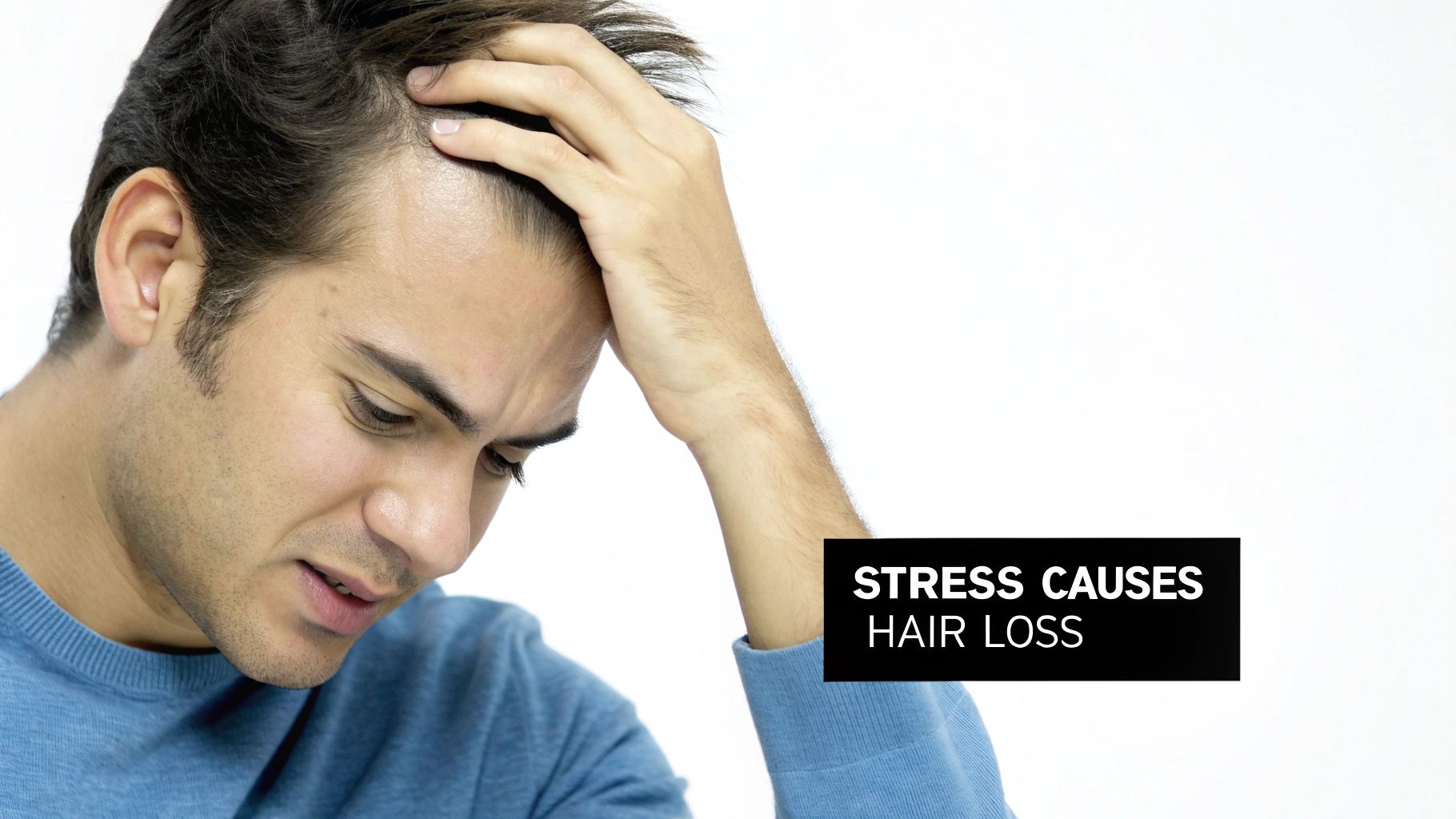
If you've ever felt like your hairbrush is collecting more strands than usual after a tough time, you're not imagining it. There's a well-documented medical connection between your state of mind and the health of your hair.
Think of your hair's growth cycle like a busy, well-organised traffic system. Normally, hairs grow, rest, and shed in a staggered, orderly fashion. But a major stressor—a demanding job, financial worries, illness, or a personal crisis—is like a sudden system-wide red light. It can shock a large number of hair follicles out of their active growing phase and push them all into the resting (shedding) phase at once.
This sudden, mass shedding is called telogen effluvium. It’s by far the most common type of hair loss triggered by stress.
The crucial thing to realise is that the hair you see falling out today is often a delayed reaction to stress you went through two or three months ago. This lag makes it tricky to connect the dots, but the link is undeniable.
Here in Australia, we're seeing this more and more. The pressures of modern life mean about 50% of men experience noticeable balding by age 50, and 40% of women see visible thinning by age 40. Stress can often hit the accelerator on this process, particularly for younger Aussies.
Quick Guide to Stress and Hair Loss
To put it all into perspective, here's a simple breakdown of how stress impacts your hair.
| Aspect | Key Detail |
|---|---|
| Primary Trigger | Significant emotional or physical stress (e.g., job loss, illness, surgery). |
| Main Type of Hair Loss | Telogen Effluvium: a sudden, diffuse shedding all over the scalp. |
| Biological Mechanism | Stress hormones (like cortisol) push many hair follicles into the 'resting' phase prematurely. |
| Timeline | Hair loss typically starts 2-3 months after the stressful event. |
| Outlook | Usually temporary. Hair often regrows within 6-9 months once the stressor is managed. |
This table shows that while the shedding can be alarming, the good news is that it’s often reversible once the underlying stress is under control.
Of course, it's vital to know what you’re dealing with. Stress-related shedding is different from other conditions. To get a clearer picture, it's worth understanding what causes male pattern baldness, which follows very different genetic patterns. This guide will walk you through the specifics of stress-induced hair loss and what you can do about it.
The Three Types of Stress-Related Hair Loss
When we talk about stress making your hair fall out, it’s not just one thing. Stress can actually trigger a few different types of hair loss, and each one looks and behaves differently. Figuring out which one you might be dealing with is the first real step toward getting things back on track.
Think of it like this: stress can give you a tension headache, a nervous stomach, or knotted shoulders. It’s the same trigger, but the symptoms are different. The same goes for your scalp. Let’s walk through the three main ways stress can impact your hair.
Telogen Effluvium: The Mass Shedding
The most common culprit by a long shot is Telogen Effluvium (TE).
Picture your hair follicles as being on a strict schedule. At any given time, about 85-90% of them are busy in a growth phase (anagen), while the rest are chilling out in a resting phase (telogen) before they naturally shed.
But when a major stressor hits your system—think a serious illness, surgery, or a period of intense emotional turmoil—it's like a fire alarm goes off in your body. This shock abruptly shoves a huge percentage of your growing hairs, sometimes up to 30% or more, straight into that resting phase.
You could call Telogen Effluvium a "mass exodus." Hairs that were meant to keep growing for years are suddenly given their marching orders. The result is a noticeable, all-over thinning that typically shows up two to three months after the triggering event.
Alopecia Areata: A Case of Mistaken Identity
Next up is Alopecia Areata. This is an autoimmune condition, and we know that severe stress is a major trigger for flare-ups.
What happens here is that stress seems to scramble the signals within your immune system. It gets confused and starts seeing your own healthy hair follicles as a threat, like a virus or bacteria it needs to eliminate.
It’s a classic case of friendly fire. Your body’s defence system launches an attack on your follicles, causing the hair to fall out in distinct, smooth, and often perfectly round bald patches. These can appear on your scalp, beard, or anywhere else on the body.
The pattern is starkly different from TE's diffuse thinning. Because of the patchy nature, many people look for cosmetic solutions to regain their confidence. Options like scalp micropigmentation for Alopecia can be incredibly effective at camouflaging the patches and restoring the look of a full head of hair.
Trichotillomania: A Compulsive Response
Finally, we have Trichotillomania, which is a bit different. This condition is less about your body’s internal chemistry and more about an overwhelming behavioural urge. It's a disorder where someone feels an irresistible compulsion to pull out their own hair.
For many people, the act of pulling hair from the scalp, eyebrows, or eyelashes becomes a way to cope with negative or uncomfortable feelings like stress, anxiety, or even boredom. The pulling itself provides a fleeting moment of relief, which unfortunately reinforces the behaviour and creates a cycle that’s tough to break.
Here, the hair loss is a direct result of the physical action, leading to patchy bald spots and, over time, potential damage to the hair follicles themselves.
How Stress Disrupts Your Hair Growth Cycle
To get to the bottom of why you might be shedding more hair than usual, we need to look at what’s happening on a biological level—the very real connection between your mind and your hair follicles. The main culprit here is cortisol, a hormone that most of us know simply as the "stress hormone."
When you're under the pump, whether from work, life, or a sudden shock, your adrenal glands go into overdrive, pumping out cortisol to help your body manage the pressure.
Think of your hair follicles as a beautifully synchronised production line. Cortisol is like an emergency alarm that suddenly blares through the factory. This hormonal surge sends a shockwave through your system, throwing the delicate and predictable hair growth cycle completely out of whack.
This disruption abruptly forces a large number of hairs out of their active growing phase (anagen) and shoves them straight into the resting and shedding phase (telogen). It's essentially a system-wide "abandon ship" signal for your follicles.
The Cortisol Connection
Here in Australia, this phenomenon—known as telogen effluvium—is a common cause of diffuse hair thinning all over the scalp, rather than distinct bald patches. You'll typically notice the shedding start about three months after a major stressful event.
With statistics showing that a staggering 40% of women by age 40 are already dealing with visible hair loss, stress is a massive, often overlooked, part of the puzzle. When stress becomes chronic, it keeps those cortisol levels high, which can directly suppress the stem cells in your hair follicles, holding them in that resting phase for longer and delaying new growth.
The map below gives a great visual of how stress can trigger different hair loss conditions.
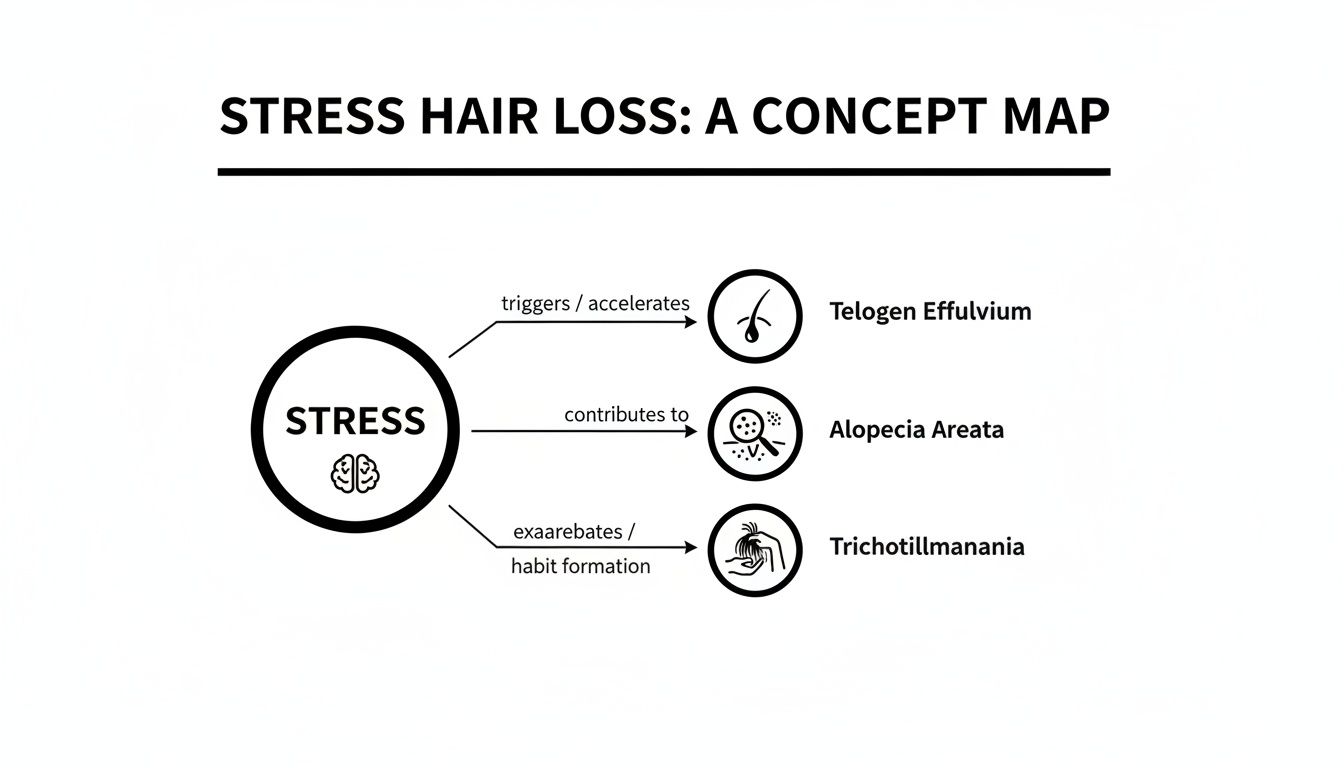
As you can see, that one trigger—stress—can set off a chain reaction leading to very different outcomes, from all-over shedding to patchy loss or even compulsive hair pulling.
Your Follicles Can Reset
So, what does all this biology mean for you? It means that what you're experiencing is a real, physiological event. It's not "just in your head." Realising this is the first, and most important, step toward finding a solution.
The key takeaway here is that your hair growth cycle is a finely tuned system. During times of intense stress, your body is in survival mode. It redirects all its energy to essential functions, and unfortunately, growing a full head of hair doesn't make the cut.
The good news is that for most types of stress-related hair loss, the follicles themselves aren't permanently damaged. Once the stress is managed and your cortisol levels normalise, the growth cycle can—and usually does—reset itself.
Understanding the different phases of hair growth can be incredibly empowering. It helps you recognise what’s happening and gives you the knowledge to support your body's natural recovery process.
Is Stress Behind Your Hair Loss? Here’s How to Tell
Trying to figure out if stress is the reason your hair is thinning can feel like a bit of detective work. There are so many potential culprits, from your genes to your diet, so you have to know what clues to look for. The biggest tells are usually the timing, the speed, and the pattern of your hair loss.
Genetic hair loss, for instance, tends to creep up on you slowly over many years. Stress-induced shedding is the opposite—it's often sudden and quite alarming. You might abruptly notice way more hair on your pillow in the morning, a bigger clump in your hairbrush, or a worrying amount clogging up the shower drain.
What makes it tricky is the delay. This kind of accelerated shedding usually kicks in about two to three months after a major stressful event, which can make it hard to connect the dots back to the source.
Key Signs to Look For
The way your hair is thinning is another massive clue. Is it disappearing from one specific spot, or does it seem to be happening all over?
Stress-related hair loss, especially a condition called Telogen Effluvium, almost always causes diffuse thinning. This means you'll notice a general drop in hair volume across your entire scalp, rather than a classic receding hairline or a bald patch forming on your crown.
If you want a more objective way to measure how much pressure you're under, you can use a tool like the Subjective Units of Distress (SUDS) Scale. It helps you put a number on your stress levels, which can make it easier to see a potential connection to what's happening with your hair.
The bottom line is this: if your hair loss started suddenly and seems to be thinning out evenly all over your head, there's a very good chance that stress is the prime suspect. It's a completely different pattern from the slow, predictable march of hereditary baldness.
Comparing Hair Loss Causes
Telling the difference between stress-related shedding and genetic hair loss is the most important step in finding the right solution. They might both feel distressing, but they have very different signatures. Getting a handle on these differences will help you have a much more productive chat with a doctor or specialist.
To make it easier, let's break down the key distinctions.
Comparing Hair Loss Causes
| Symptom | Stress-Induced Hair Loss (Telogen Effluvium) | Genetic Hair Loss (Pattern Baldness) |
|---|---|---|
| Speed of Onset | Sudden and rapid, usually showing up 2-3 months after a stressful event. | Gradual and progressive, developing slowly over many years. |
| Pattern of Loss | Diffuse thinning all over the scalp, leading to a general loss of volume. | Predictable patterns, like a receding hairline, thinning crown, or a widening part. |
| Amount of Shedding | Noticeably increased daily shedding on pillows, in showers, and on brushes. | Shedding might be slightly higher than normal, but it's not usually the main sign. |
| Scalp Condition | The scalp usually looks healthy and normal, with no irritation or redness. | The scalp is typically healthy, though follicles shrink over time (miniaturisation). |
| Recovery Outlook | Often temporary and reversible once the underlying stress is dealt with. | Permanent and progressive, though treatments can often slow it down. |
Think of this table as a quick checklist to help you make sense of your symptoms. If what you're seeing lines up more with the left-hand column, it's a strong indicator that stress is at the heart of the issue. This isn't a diagnosis, but it's a fantastic starting point before you seek a professional opinion and start looking at your options.
Your Action Plan for Recovery and Regrowth

Knowing why your hair is thinning is the first step, but taking action is how you really start to get your confidence back. The best plans hit the problem from two sides: dealing with the root cause (stress) while also managing the symptom you see in the mirror (the hair loss itself). This two-pronged approach is your fastest route to breaking the cycle and feeling like yourself again.
The most critical piece of the puzzle is lowering the physiological stress that’s forcing your hair follicles into that premature shedding phase. It's one thing to know there's a link, but learning how to deal with chronic stress effectively is the real foundation for recovery.
Kickstarting Your Body's Recovery
Your body has an amazing ability to heal itself, but you have to give it the right environment to do so. You can create the perfect conditions for recovery by focusing on a few key areas that directly fight the effects of cortisol and encourage your hair cycle to get back on track.
- Mindfulness and Relaxation: Simple techniques like meditation, deep breathing exercises, or even just a quiet walk can make a huge difference in lowering stress hormones. Just 10-15 minutes a day is enough to start calming your nervous system.
- Regular Exercise: Getting your body moving is one of the best ways to burn off excess cortisol. Try to get in some moderate-intensity exercise, like a brisk walk, jog, or bike ride, on most days of the week.
- Targeted Nutrition: Hair follicles are hungry! They need the right fuel to build strong, healthy hair. Make sure your diet is packed with iron, zinc, biotin, and protein. For a deeper dive, check out our guide on how to prevent hair loss naturally.
This isn't about doing one thing; it's about a combined effort to stabilise your internal systems. It’s like sending a clear signal to your follicles that the "danger" has passed and it's safe to start growing again.
Finding an Immediate Confidence Boost
While you're working on the long-term fix, you need a solution for right now. Waiting months for your hair to fill back in can be a source of stress all on its own. This is why tackling your appearance is such a powerful part of the healing process, and where Scalp Micropigmentation (SMP) can provide immediate relief.
SMP isn't a treatment to make hair grow. Think of it as a highly advanced cosmetic tattoo that perfectly mimics the look of individual hair follicles. For both men and women, it instantly creates the illusion of thicker, denser hair, camouflaging thin patches and restoring a natural-looking hairline.
The great thing about this non-invasive procedure is that you see results from the very first session. That immediate visual improvement gives you a much-needed confidence boost, which is so important for breaking the vicious cycle where worrying about your hair loss actually creates more stress.
When You Should See a Professional
While most stress-related shedding does sort itself out over time, it's really important to know when it’s time to call in an expert. Your first port of call should be your GP or a dermatologist, especially if you spot any red flags that suggest it might be more than just a temporary, stress-induced issue.
Getting a proper diagnosis is the only way to be certain. It helps rule out other underlying health problems that could be causing your hair to fall out and gets you on the right track from day one.
Key Signs to See an Expert
It's definitely time to book an appointment if you're experiencing any of these:
- Prolonged Shedding: The shedding has been going on for more than six months and isn't showing any signs of slowing down.
- Distinct Bald Patches: You’re finding smooth, clearly defined bald spots. This can be a tell-tale sign of alopecia areata.
- Scalp Discomfort: Your scalp feels painful, itchy, red, or looks inflamed. These aren't typical symptoms of stress-related shedding alone.
- Rapid and Severe Loss: The hair loss has come on suddenly and aggressively, and it's causing you a lot of distress.
Getting a proper diagnosis from a hair specialist for alopecia or a dermatologist is the most powerful tool you have. It shifts you from a place of worry to a position of control, armed with a clear understanding and a targeted plan.
From that point, you can start to explore all the avenues available to you. An experienced SMP practitioner can also be a key part of your support network. They offer a way to immediately reclaim your appearance and confidence, which can make a huge difference in managing the emotional side of hair loss while you and your doctor work on the root cause.
Your Questions Answered: Stress and Hair Loss
When you're dealing with hair loss, a million questions can pop into your head. It's completely normal to want specific answers, so we've put together a quick FAQ to clear things up and give you a bit more control over the situation.
Think of this as a straightforward chat to reinforce what you’ve learned so far. Getting a handle on the details is a huge part of managing your hair's recovery and getting your confidence back.
How Long Does It Take for Hair to Grow Back After Stress?
For telogen effluvium, which is the most common kind of stress-induced shedding, the news is generally good. Once the source of the stress is gone or at least under control, you should notice the heavy shedding starts to ease up.
Most people see their hair start to regain its usual thickness within three to six months. Patience is key here. Hair only grows about 1.25 centimetres a month, so it takes a little while before you can really see the results of your recovery.
Can Chronic, Low-Grade Stress Cause Hair Loss Too?
Without a doubt. We often think of hair loss being triggered by a single, traumatic event, but that simmering, long-term stress can be just as bad for your hair.
This constant, low-level pressure keeps your body’s stress hormone, cortisol, elevated. Over time, that can steadily interfere with your hair's natural growth cycle, leading to a more gradual but persistent thinning. That's why managing your day-to-day stress is so important for keeping your hair healthy in the long run.
The key is to quieten that internal alarm system that’s constantly telling your hair follicles it's time to shut down. Both sudden shocks and that endless background hum can keep the alarm bells ringing.
Is Scalp Micropigmentation a Good Solution for Temporary Hair Loss?
Yes, Scalp Micropigmentation (SMP) can be a fantastic option while you're waiting for your hair to grow back. It offers an instant visual fix by creating the illusion of density, which can be a massive psychological boost.
SMP works by expertly camouflaging the thinner patches, giving both men and women an immediate confidence lift. Then, as your own hair starts growing back in, it just blends right in with the treatment. It’s a great way to feel and look your best throughout the entire recovery journey.
If you're looking for an immediate way to restore the look of thicker, fuller hair, My Transformation can help. Learn more about our Scalp Micropigmentation services and book your consultation today.