
Scalp Micropigmentation Training A Guide To Launching Your Career
Thinking about a career change? Starting a journey into Scalp Micropigmentation (SMP) is so much more than just learning a new trade. It's about stepping into a profession that genuinely changes lives, offers real personal fulfilment, and gives you the keys to your own financial future. This isn't just another job—it's a direct path to restoring confidence in others while building a business you can be proud of.
Why an SMP Career Is a Fulfilling Choice
A career in SMP is a fantastic mix of art, precision, and genuine human connection. Unlike many other fields that demand years of expensive university degrees, scalp micropigmentation training offers a much quicker, more accessible way to launch a successful and profitable career. Practitioners aren't just dotting pigment on a scalp; they're delivering incredible, life-altering results for clients dealing with hair loss, which can be a massive blow to someone's self-esteem.
The Personal and Professional Rewards
Honestly, the satisfaction you get from this work is huge. Picture the moment you reveal a perfectly blended, natural-looking hairline to a client who hasn't felt confident about their appearance in years. As their artist, you become a crucial part of their journey back to feeling like themselves again. For passionate practitioners like Michael here at My Transformation, that human element is the real heart of the business—it’s all about making a tangible, positive impact.
Beyond the feel-good moments, the professional perks are hard to ignore:
- Be Your Own Boss: You get to call the shots. Set your own schedule, build a brand that reflects your values, and directly control how much you earn.
- High Demand: Hair loss affects a huge number of people, so skilled, professional SMP artists are always in demand.
- Creative Outlet: Every client is a unique canvas. You’ll be using your artistic eye to design hairlines and create density that perfectly suits each individual.
A Growing Industry with Low Barriers to Entry
The demand for properly qualified SMP artists is really taking off, especially here in Australia. The whole scalp micropigmentation training scene has exploded since about 2015, which lines up with a 25% rise in hair loss treatments across the country. That growth is particularly strong in Western Australia, where over 40% of men over 50 are dealing with noticeable balding.
With startup costs often under $5,000, SMP training gives you a fast track into a field where WA practitioners can see a 200% ROI in their very first year. You can dive deeper into industry trends over at Scalp Revival SMP.
For many, choosing an SMP career isn't just about the income. It's about finding a profession that feeds your soul, challenges your artistic skills, and allows you to make a visible difference in someone's life every single day.
When you're first exploring this path, it helps to have a clear picture of what's involved. Think of the table below as a quick-start guide to the most important things you'll need to consider as you research different training options.
Key Considerations for Your SMP Training Journey
| Key Aspect | What You Need to Know |
|---|---|
| Course Curriculum | Does it cover colour theory, skin anatomy, hairline design, and different needle techniques? Look for comprehensive content. |
| Hands-On Practice | The course must include extensive practice on live models under direct supervision. This is non-negotiable. |
| Instructor Experience | Who is teaching you? Look for an experienced, working artist with a strong portfolio and a passion for mentoring. |
| Class Size | Smaller classes (e.g., 1-on-1 or 2-on-1) mean more personalised attention and better learning outcomes. |
| Post-Training Support | What happens after you graduate? Good providers offer ongoing mentorship and support as you start your business. |
| Certification & Health Laws | Ensure the training prepares you for WA Health Department compliance and provides a recognised certificate. |
Having these points in mind will help you cut through the noise and find a program that truly sets you up for long-term success.
This powerful combination of deep personal satisfaction and strong financial potential makes SMP a brilliant career choice. It's a rare opportunity to build a business that is both profitable and genuinely purposeful, transforming lives—including your own—one client at a time.
What to Expect From a Top-Tier SMP Training Course
Choosing the right scalp micropigmentation training is hands-down the most critical decision you'll make at the start of your new career. A genuinely top-tier course isn't just about watching someone else perform the technique; it's about building a solid foundation of knowledge so you can walk into any client scenario with complete confidence.
Frankly, not all training programs are created equal. Knowing what a truly excellent curriculum looks like is the first step. You'll find that a quality course is structured logically, guiding you from essential theory right through to practical, hands-on application. It's helpful to understand what goes into creating effective training programs because it gives you a lens to spot a well-designed course that’s actually built to set you up for success.
The Bedrock of Theory and Safety
Before you even think about picking up an SMP machine, you have to get the fundamentals down pat. A comprehensive course will spend a good chunk of time on the theory, making sure you understand the 'why' behind every single move you make.
This core theoretical knowledge should always include:
- Skin Anatomy and Physiology: You absolutely need to know the layers of the skin, how it heals, and how different skin types—oily, dry, sensitive—will react to pigment. Getting this right is what prevents common mistakes like the pigment blurring or changing colour down the track.
- Colour Theory and Pigmentology: This is so much more than just picking a shade of black. You'll learn how to properly assess a client's skin undertones, often using tools like the Fitzpatrick Scale, to mix pigments for a hyper-realistic result that won’t fade to an unnatural blue or grey.
- Health, Safety, and Sterilisation: In Australia, this is non-negotiable. Your training must give you the full rundown on WA Health Department regulations, blood-borne pathogen certification, and the strict sterilisation protocols for your equipment and workspace.
This flowchart shows just how direct the path to an SMP career can be when you start with quality training.
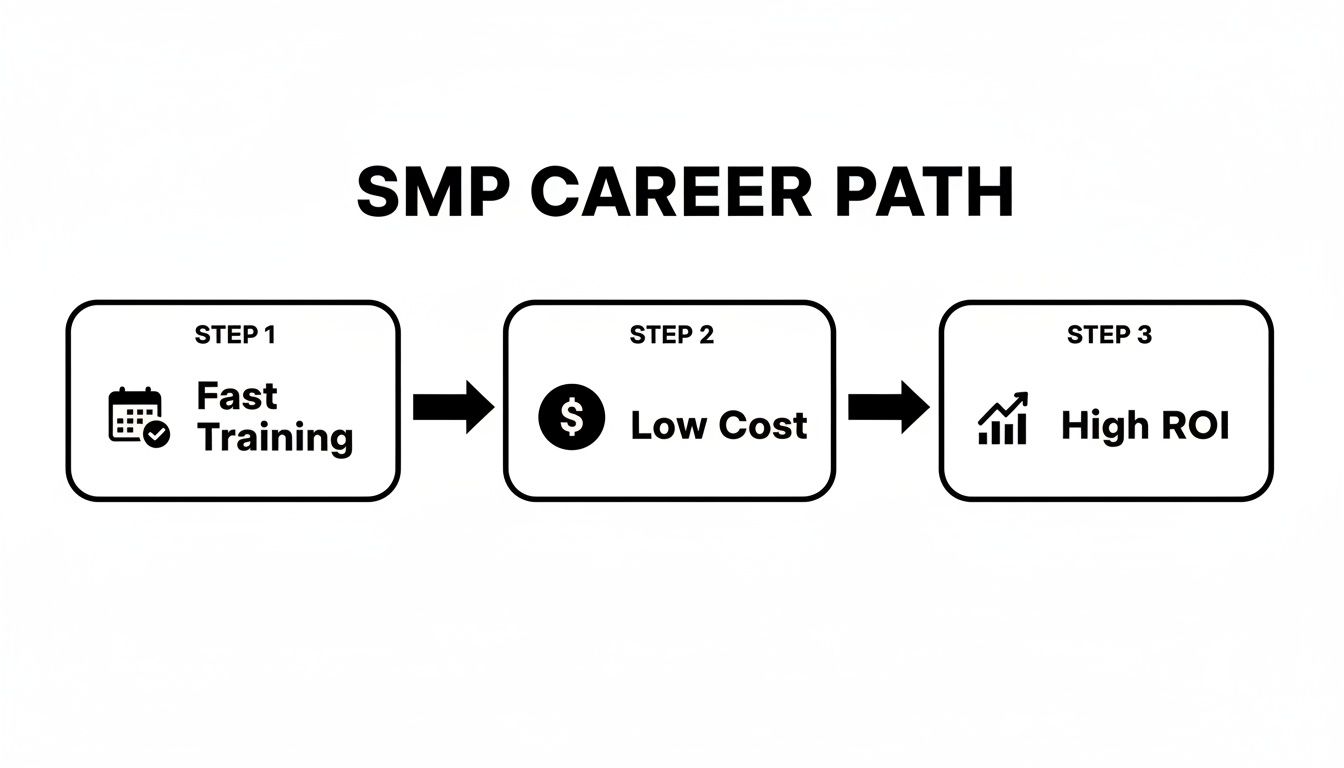
As you can see, it all starts with fast, focused training which quickly leads to a career with an excellent return on your investment.
Mastering the Art of Application
Once you’ve got the theory locked in, the focus pivots to the hands-on skills. This is where the magic happens, and where you learn to turn your knowledge into flawless results for your clients. Any training course worth its salt will give you plenty of supervised practice.
The single most important part of any SMP training is getting to work on live models. Practice pads are great for getting the feel of the machine, but nothing—and I mean nothing—compares to the experience of working on real human skin with all its unique textures and challenges.
You'll get to grips with a range of essential techniques, each one demanding its own unique approach.
Advanced Techniques and Hairline Design
Creating a result that looks completely natural is about more than just putting dots on a scalp. A truly elite training program will teach you the artistry needed to design and deliver treatments that are completely customised to each client.
Key artistic skills you should expect to learn are:
- Hairline Design: This is where art meets science. You’ll learn to create all kinds of hairlines—from sharp and defined to soft and naturally receded—that are age-appropriate and perfectly frame a client's face.
- Density Fills: You'll master the delicate technique of adding the illusion of thickness to thinning hair for both men and women, blending your work seamlessly with their existing hair.
- Scar Camouflage: This is a specialised skillset. You'll learn how to expertly conceal scars from hair transplants (both FUT and FUE) or injuries, which requires a very precise touch and perfect pigment matching.
Understanding these finer points is what separates a good technician from a true artist. If you're keen to dive deeper into the practical side of things, check out our detailed guide on https://www.mytransformation.com.au/blogs/news/how-to-learn-scalp-micropigmentation.
Ultimately, a great SMP course gives you more than just a new skill; it gives you the ability to problem-solve. It gets you ready for the real world of running a business—from the first consultation and managing client expectations right through to aftercare. You should walk away feeling 100% ready to handle any client need, uphold the highest safety standards, and start building your professional reputation from day one.
Choosing the Right Scalp Micropigmentation Training Provider
Deciding to train in scalp micropigmentation is a huge career move, but picking the right academy is where the real work begins. Let's be honest, there are a lot of options out there, and it's easy to get overwhelmed.
But if you know what to look for, you can quickly spot the genuine experts from the crowd. The quality of your training is the foundation of your entire career. A shaky start will only lead to headaches later, so this is one area you really don't want to cut corners. A good starting point is to explore different beauty industry trainings and certifications to get a feel for what high-quality professional development looks like.
Look for an Instructor, Not Just an Artist
First thing's first: who is actually going to be teaching you? Being a brilliant SMP artist doesn't automatically make someone a great teacher. You need to find an instructor who not only has a stunning portfolio of real-world results but also a real passion for mentoring others.
It’s crucial to find a trainer who is still actively working on clients every week. This is your guarantee that their techniques are fresh and relevant to what clients want right now. An artist who no longer sees clients day-to-day might be teaching methods that are already becoming outdated.
Prioritise Small Class Sizes
This one is non-negotiable. To really learn this craft, you need personalised attention. Big group classes might seem cheaper upfront, but they simply can’t offer the detailed, one-on-one feedback that’s essential for mastering SMP. It's too easy for bad habits to form and mistakes to go unnoticed in a crowd.
For this reason, you need to insist on training that offers either:
- One-on-one training: This is the gold standard. It’s an immersive experience built completely around your learning style and speed.
- Tiny groups: If one-on-one isn't available, a class with no more than two or three other students is the only alternative to consider.
An intimate setting like this means your instructor is watching your every move. They can correct your hand pressure on the spot, refine your technique, and answer all your questions as they come up.
A great training provider invests in your success, not just your enrolment fee. The best sign of this is a commitment to small, focused classes where you are the priority. This is where you truly refine your craft.
Insist on Live Model Practice
Practising on fake skin or even a melon is fine for getting used to holding the machine. But it's nothing like the real thing. A top-tier training course must include plenty of supervised practice on actual live models.
Real human skin is complex. It has different textures, levels of oiliness, and varying thickness across the scalp—things you just can't replicate on a practice mat. Working on a live person, with your mentor guiding you, is where you build genuine confidence. It’s where you learn how to design a natural hairline on a real head, manage a client’s comfort, and see for yourself how the pigment actually heals in the skin.
If a course doesn't guarantee you'll be working on live models, consider it a massive red flag. For a closer look at what a comprehensive program should offer, check out our guide on SMP training in Perth.
Verify Ongoing Support and Mentorship
So, what happens the day after you get your certificate? It’s a question most students forget to ask, but it's one of the most important. Your training course isn't the finish line; it’s the starting line. Facing your first few solo clients can be pretty nerve-wracking.
A reputable trainer knows this and will offer solid, ongoing support. This could be a direct phone number to your instructor for quick questions, access to a private group of fellow graduates, or even opportunities to come back for refresher sessions.
Knowing you have that safety net is invaluable as you start your career. Before you sign up anywhere, ask them directly: "What does your post-graduation support look like?" Their answer will tell you everything you need to know.
Building Your SMP Business After Certification

Holding that certificate in your hands feels incredible, doesn't it? It's the culmination of all your hard work and practice. But this isn't the finish line—it's the starting gate. Now the real fun begins: turning your skills into a thriving, profitable business. This is where your journey as an entrepreneur truly starts.
Building a business from scratch can feel like a massive undertaking, but with a clear plan, it's completely achievable. Success really boils down to three things: solid business fundamentals, smart marketing, and treating your clients exceptionally well. Think of this as your practical playbook for launching a successful SMP practice right here in Australia.
Laying the Legal and Financial Groundwork
Before you even think about welcoming your first client, you need to get the boring (but essential) stuff out of the way. Setting up a professional foundation from day one ensures you’re operating legally and protects both you and your clients. Getting this right is crucial for your long-term stability and growth.
Your first priorities should be:
- Registering Your Business: Your absolute first step is getting an Australian Business Number (ABN). This is a unique 11-digit number that identifies your business to the government and is a must-have for invoicing and taxes.
- Securing the Right Insurance: Public liability and professional indemnity insurance are completely non-negotiable. This coverage protects you from claims related to accidents, injuries, or professional mistakes, giving you critical peace of mind.
- Understanding Local Health Regulations: Here in Western Australia, you must comply with the Department of Health's regulations for skin penetration procedures. This means making sure your studio meets specific hygiene standards, sterilisation protocols, and documentation requirements.
These steps aren't just about ticking boxes; they establish your credibility and show potential clients that you're a serious professional they can trust.
The earning potential after completing scalp micropigmentation training in Australia is genuinely impressive. WA artists, like those we train at My Transformation, can realistically earn between $100,000-$250,000 annually. Even part-timers often pull in $50,000-$100,000 a year, while seasoned pros with a loyal client base can easily surpass $250,000. This is backed by a 40% surge in SMP demand across Australia post-2020, fuelled by Western Australia's 2.5 million population where 1 in 3 men are looking for hair restoration solutions.
Crafting a Powerful Marketing Strategy on a Budget
With your business officially set up, it’s time to find some clients! The good news is you don't need a massive marketing budget to make a real impact. A few smart, targeted strategies that highlight your skills can generate a steady stream of leads without breaking the bank. Your main goal here is to build trust and show off your expertise.
Your most powerful marketing tool is your portfolio. Start right now by documenting your work on every single live model from your training. Take high-quality, well-lit "before" and "after" photos from multiple angles. A compelling portfolio is the visual proof of your talent and the single most effective way to convince someone to book a consultation.
From there, you can focus your energy on a few key digital channels that really work.
Leveraging Social Media and Local SEO
For a visual service like SMP, social media platforms like Instagram and Facebook are an absolute goldmine. They're the perfect place to share your portfolio, post client testimonials, and connect directly with your local community.
Create a professional business page and get into a rhythm of consistently posting your best work. Use relevant hashtags like #SMPPerth or #ScalpMicropigmentationWA to help people who are actively searching for your services find you.
Beyond social media, making sure you show up on Google is essential. Basic local Search Engine Optimisation (SEO) can make a world of difference. Start by creating a free Google Business Profile. Fill it out completely with your business name, address, phone number, and opening hours. Most importantly, encourage your happy clients to leave reviews—that positive feedback will give your local search ranking a massive boost.
Setting up your business can feel overwhelming, so here's a simple checklist to keep you on track.
Your Essential SMP Business Launch Checklist
This checklist breaks down the key administrative and marketing tasks you'll need to tackle to get your SMP business off the ground.
| Business Setup Task | Key Action | Why It's Important |
|---|---|---|
| Business Registration | Apply for an Australian Business Number (ABN) and register your business name. | This is a legal requirement for operating a business in Australia and is essential for tax and invoicing. |
| Insurance | Obtain Public Liability and Professional Indemnity insurance policies. | Protects you financially from claims of accidental injury, property damage, or professional negligence. |
| Health & Safety | Register with your local council and ensure your studio meets WA Health guidelines. | Guarantees you are operating legally and safely, building trust with clients and avoiding fines. |
| Bank Account | Open a separate business bank account. | Keeps your personal and business finances separate, making bookkeeping and tax time much simpler. |
| Build Your Portfolio | Take high-quality before & after photos of every client, starting with your training models. | Your portfolio is your number one sales tool. It visually demonstrates your skill and the results you can deliver. |
| Online Presence | Create a Google Business Profile and social media accounts (Instagram/Facebook). | Makes your business discoverable to local clients searching for SMP services online. |
| First Reviews | Ask your first few happy clients to leave a review on your Google Business Profile. | Social proof is powerful. Positive reviews build credibility and significantly improve your local search ranking. |
Working through these steps methodically will give your new venture the professional, secure foundation it needs to succeed.
Perfecting the Client Experience
Your technical skills will get clients in the door, but an outstanding client experience is what will turn them into raving fans who send their friends your way. Word-of-mouth marketing is incredibly powerful, and it all starts with how you treat people.
Mastering the consultation is key. This is your chance to really listen to a client's story, understand their insecurities and goals, and set realistic expectations. Explain the process clearly, answer every single question they have, and provide a transparent, easy-to-understand price. A client who feels heard and respected is a client who trusts you.
Of course, having the right tools is part of delivering a great experience. Our guide on wireless tattoo machines for SMP artists can help you select the best equipment for the job.
Finally, a structured follow-up process shows you care beyond the final payment. Check in with your clients a few weeks after their last session to see how everything has healed and settled. This small gesture builds lasting relationships and is often the trigger for those glowing reviews and referrals that will become the lifeblood of your new business.
Advancing Your Skills And Mastering The Craft
Finishing your initial scalp micropigmentation training is a fantastic achievement, but it’s really just the beginning. Think of it as the launchpad for your career, not the final destination. The true masters in this industry know that the learning never stops. SMP is always evolving, and committing to ongoing professional development is what will really set you apart from the crowd.
I like to compare it to getting your driver's licence. You've passed the test and know the rules, but it takes years of real-world experience to become an intuitive driver who can handle anything the road throws at you. SMP is exactly the same; nailing the fundamentals is just the first step in your artistic journey.
Pursuing Advanced SMP Techniques
Once you’re feeling confident with your standard density work and hairline designs, it’s time to push yourself and branch out into more specialised areas. Adding advanced techniques to your repertoire doesn't just mean you can help more clients; it positions you as a genuine expert, which also means you can start charging premium prices for your skill.
Here are a few key areas to look into for advanced training:
- Corrective Work: Learning how to fix bad SMP from other clinics is an incredibly valuable—and profitable—skill. This could involve anything from correcting pigment that’s turned blue to softening out harsh, unnatural-looking hairlines or camouflaging dots that are far too large.
- Advanced Scar Camouflage: Your foundation course probably touched on basic scar work. But mastering the art of concealing large FUT (strip) scars or complex facial scarring requires a much deeper level of skill and a delicate touch when working with fragile scar tissue.
- Alopecia Specialisations: Working with alopecia clients brings its own unique set of challenges. Advanced training will teach you how to build a complete, natural-looking head of hair from a totally blank canvas, which demands an exceptional eye for blending and artistry.
The artists I respect most are the ones who are lifelong students. They're always hungry for new knowledge and are never satisfied with just 'good enough'. That dedication is what builds a rock-solid reputation and a business that lasts.
Staying Ahead Of Industry Innovations
The tools of our trade—the machines, needles, and pigments—are constantly improving. What was considered top-of-the-line five years ago might be old news today. Keeping up isn't about having the flashiest new gear; it’s about consistently delivering better, more predictable results for the people who trust you with their appearance.
To stay on top of your game, you’ll want to dedicate some time to keeping up with a few key areas.
Evolving Technology and Pigments
Things move fast in this field. If you want to be a top-tier artist, you need to stay in the loop on the latest developments that can take your work to the next level.
Here’s what you should be watching:
- Pigment Formulations: New pigment lines are always coming out. Some promise better longevity, others are designed to resist changing colour, and some are created specifically for certain skin types. Knowing the difference allows you to choose the perfect product for every single client.
- Needle Configurations: The sheer variety of needle cartridges available now is incredible. From tiny single needles for hyper-realistic detail to larger sloped groups for efficient shading, learning to use different configurations can completely change your technique and your final results.
- Machine Technology: The move towards powerful, wireless machines has been a game-changer, giving us more freedom and control than ever. Keeping an eye on new motors, stroke lengths, and ergonomic designs can make a real difference to your comfort and precision during those long sessions.
At the end of the day, your journey in scalp micropigmentation is an artistic one. It demands a real passion for detail, a deep-seated commitment to your clients, and the drive to be better tomorrow than you are today. When you embrace continuous learning, you stop being just a technician and become a true artist who gives people their confidence back. To dive deeper into the artistry involved, check out our guide on the thread-by-thread precision of scalp micropigmentation.
Common Questions About SMP Training
Thinking about a new career in scalp micropigmentation? It's a big move, and you've probably got a dozen questions buzzing around your head. That's completely normal. It’s a serious investment in yourself, so you need to have all the facts straight before you dive in.
We get asked the same questions all the time by people just like you, so we’ve put together some straight-up answers to help you see things clearly. Let’s get into the practical side of things, from the money you’ll need to start, to what you can actually make once you’re qualified.
Do I Need a Background in Beauty or Tattooing?
This is the big one, and the answer is a simple, resounding no.
Sure, if you’ve worked as a barber, tattoo artist, or in cosmetics, you might have a slight head start. But honestly, it's not a requirement at all. Some of the most incredible SMP artists I know came from completely different worlds—think construction, admin, you name it.
What really counts is having:
- A steady hand and a sharp eye for the small stuff.
- A genuine desire to help people feel good about themselves.
- The commitment to learn the craft inside and out, especially when it comes to hygiene and safety.
A great training course is built to take you from zero to one hundred, assuming you know nothing to begin with. We're looking for your potential and your passion, not what you did in your last job.
How Long Does SMP Training Take?
Forget about spending years at TAFE or university. Scalp micropigmentation training is fast-paced and focused. Most top-notch, in-person courses will have you skilled up in just 3 to 5 days. It’s an intensive period where you’ll soak up all the theory and, more importantly, get a ton of hands-on practice.
This isn’t about rushing you through the door. It’s a full immersion. The condensed format means you can learn the skills, work on real people under an expert’s watch, and be ready to start your new career in weeks, not years.
Don't let the short timeframe fool you into thinking it's not thorough. A brilliant 3-day course gives you more practical, real-world knowledge than you could ever get from months of trying to teach yourself from videos online. It's all about concentrated learning with an expert guiding you.
What Is the Average Cost of Training?
You have to invest in your education, and when it comes to SMP, you definitely get what you pay for. In Australia, a quality training program that gives you everything you need will typically be in the $5,000 to $10,000 range. It can be tempting to go for a cheaper online course, but this is one of those skills where in-person training is non-negotiable.
So, what does that price tag get you? A premium course should always include:
- Your full professional SMP kit (machine, pigments, needles—the lot).
- Intensive, hands-on practice on live models.
- A recognised certificate when you finish.
- Ongoing support and mentorship after you’ve graduated (this is a huge one!).
Try not to see it as a cost, but as the first investment in your own business—a business where skilled artists here in WA can comfortably earn a six-figure income. If you're still weighing it all up, check out our article on whether you should train in scalp micropigmentation for some more perspective.
What Is the Earning Potential After Certification?
Let’s talk numbers, because this is a big reason people get into the industry. Once you’re certified and have a few good results under your belt, the earning potential is massive. A standard SMP treatment for a client usually falls between $1,500 and $4,000, all depending on how much work they need.
With a steady stream of clients, it’s completely realistic for a full-time SMP artist in Western Australia to earn anywhere from $100,000 to $250,000 a year. Even if you're just doing it on the side, it's not uncommon to bring in an extra $50,000 to $100,000. Your income is in your hands—it all comes down to your skill, your reputation, and how well you get your name out there.
At My Transformation, our goal is simple: to provide the highest standard of scalp micropigmentation training that sets you up for a long, successful career. Ready to make a change? Learn more about our comprehensive training programs by visiting https://www.mytransformation.com.au.