
How to Learn Scalp Micropigmentation A Practitioner's Guide
To learn scalp micropigmentation, you need to go through a professional training program that gives you a solid mix of theory and a whole lot of hands-on practice. The journey is all about getting to grips with scalp anatomy, colour theory, and the specific needle techniques needed to create results that look incredibly real. It's this blend of technical precision and artistic vision that truly builds a successful career.
Your Career as a Scalp Micropigmentation Artist
Thinking about a career in scalp micropigmentation (SMP) isn't just about getting a new certificate for the wall. It’s about diving into an art form that genuinely restores confidence and changes people's lives. For anyone starting out in Western Australia, whether you're in a bustling Perth suburb or a regional town, having a clear roadmap is your key to success. This guide is designed to strip away the confusion and give you a straightforward plan to follow.
The first real step is to find a quality training program and immerse yourself in the fundamentals. A good course will walk you through everything from scalp anatomy and different skin types to how to conduct a professional client consultation and maintain strict hygiene standards. These core principles aren't just suggestions—they are non-negotiable for delivering treatments that are both safe and effective.
The Blend of Art and Science
Being successful in SMP comes down to a really unique combination of skills. You’re not just putting pigment into the skin; you're meticulously creating the illusion of hair density and designing a natural-looking hairline that actually suits your client’s face.
This requires a delicate balance of:
- Technical Precision: Knowing the exact needle depth, pressure, and machine speed to create tiny, consistent impressions that mimic real hair follicles.
- Artistic Vision: The knack for designing hairlines that are flattering, blending pigments seamlessly, and being able to see the final result in your mind's eye before you even start.
- Scientific Knowledge: A solid understanding of colour theory is crucial for choosing pigments that won't fade to an unnatural colour over time due to sun exposure or the client's skin undertones.
The journey from novice to expert follows a clear path, moving from core knowledge to mastering the artistry itself.
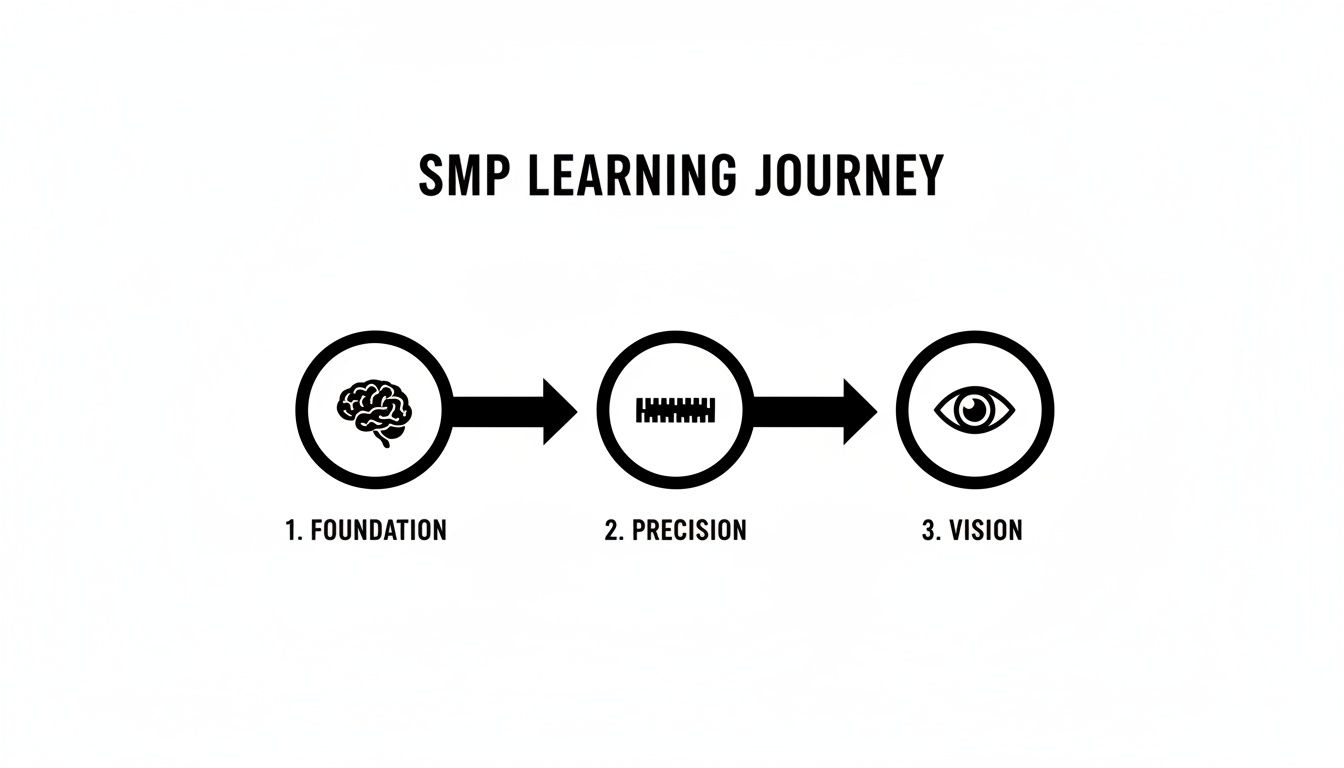
This process really shows how an artist develops, first by understanding the 'why' (foundation), then mastering the 'how' (precision), and finally, excelling at the 'what' (vision).
A Booming Industry in Western Australia
The demand for talented SMP artists is growing, and it's growing fast. Here in Western Australia, scalp micropigmentation training has really taken off, with certified programs reporting a 45% increase in enrolments between 2021 and 2025. This surge is part of a bigger picture—the Australian medical aesthetics market was valued at USD 396.4 million in 2025 and is expected to hit USD 784.8 million by 2034.
The difference between a competent technician and a great artist lies in the details—the ability to create a soft, undetectable hairline, to perfectly match pigment to skin tone, and to build density so naturally that it's indistinguishable from real hair follicles.
This growing demand means it's a fantastic time to get into the field. But it also means that choosing a high-quality training program is more important than ever. Proper education is what separates the artists who deliver amazing, long-lasting results from those whose work ends up needing to be corrected.
To get a clearer picture of what's involved, it helps to understand the specific training required to become a professional hair tattoo artist. A rewarding and lasting career is built on a solid foundation of expert knowledge and meticulous practice, setting you up for success right from your very first client.
Mastering the Core Skills of SMP
A top-tier training program isn't just about learning to use a machine; it's a deep dive into the science and art of scalp micropigmentation. This is where you build the skills to ensure every treatment is safe, effective, and looks incredible. Frankly, this level of knowledge is what will set you apart from the competition.
The journey to learn scalp micropigmentation really begins with a solid theoretical foundation. This isn't just fluffy background info—it's the core science that helps you sidestep common, costly mistakes like pigment migration or unnatural colour shifts down the road.
The Science Behind the Art
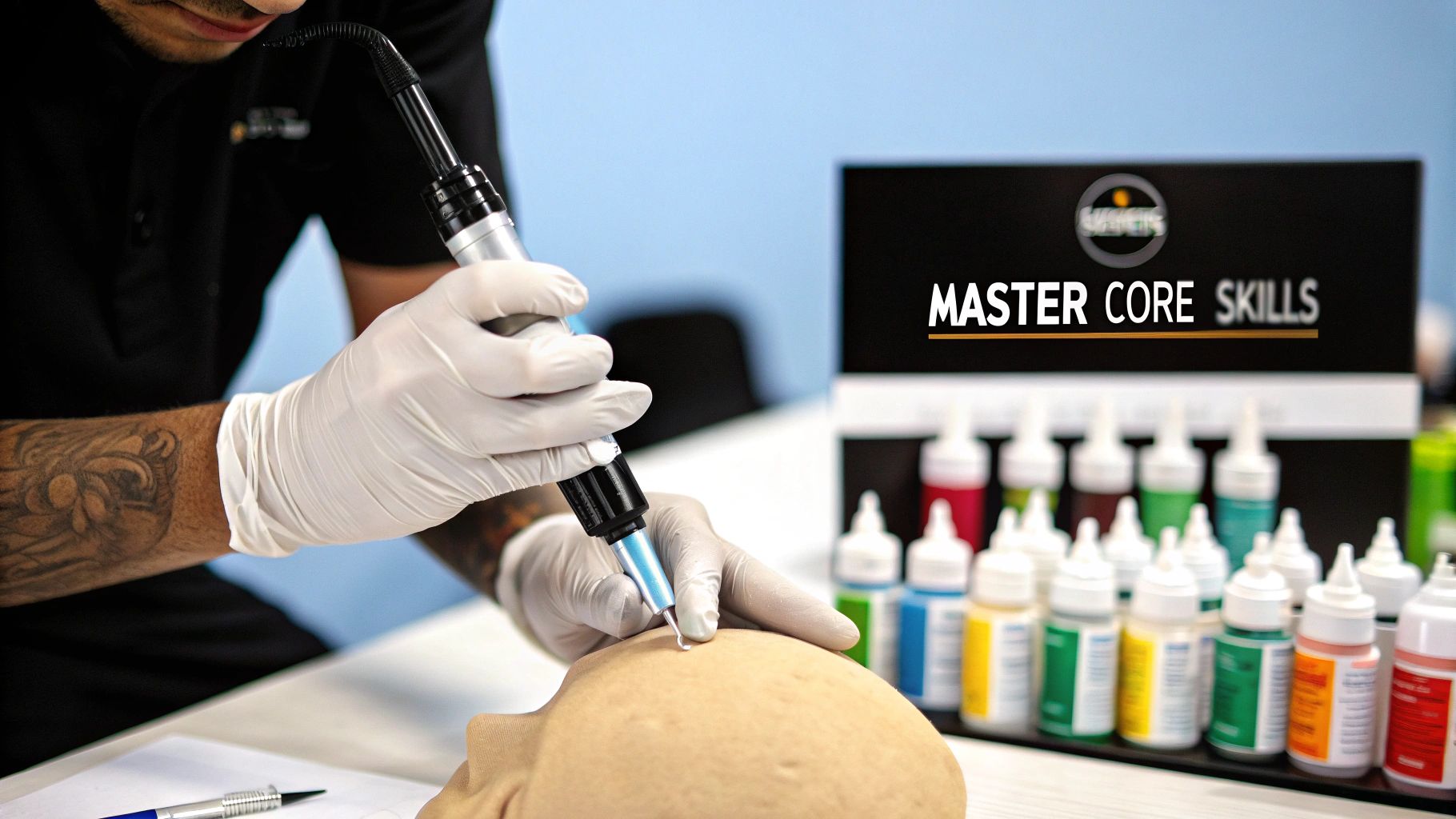
Before you even think about picking up an SMP machine, you have to understand the canvas: the human scalp. Any quality course will spend significant time on scalp anatomy and skin theory. You'll learn about different skin types (oily, dry, sensitive), how thick the skin is in different areas, and how all these factors affect pigment retention and the healing process.
Then there's pigmentology—the chemistry of the pigments themselves. This is crucial: SMP pigments are not the same as standard tattoo ink. They are specifically made to hold their colour and shape over time. Understanding their makeup is key to predicting how a treatment will look years from now.
Essential Training Components
A comprehensive curriculum has to prepare you for the real world, which means covering a few key areas in serious detail.
- Colour Theory and Pigment Selection: This goes way beyond just picking "black" or "brown." You'll learn how to properly assess a client’s skin undertones (cool, warm, neutral) and choose a pigment that complements them. This ensures the result looks natural from day one and as it ages. Especially in a sunny climate like Western Australia, you absolutely must understand how UV exposure will affect pigments over time.
- Needle Knowledge and Application: You’ll get familiar with different needle sizes and configurations, like a 3-point or 5-point needle, and what each one is used for. Different needle groupings create different effects, whether you're building a soft, feathered hairline or creating dense coverage across the crown.
- Machine Control and Technique: Mastering your equipment is everything. Training should be heavily focused on developing a steady hand, controlling pigment depth (too deep causes blowouts, too shallow means it fades quickly), and keeping consistent pressure to create thousands of uniform follicle impressions.
The way we train for SMP has come a long way. Looking back, formal training protocols really started taking shape here in Perth around 2015. It's no coincidence that this coincided with a 150% rise in hair loss clinics across Western Australia by 2025. Today, a well-structured curriculum often includes around 120 hours of training, with a split of about 40% theory and 60% hands-on practice. This model is designed to get you ready for the standard 2-4 session client process. If you want to dig deeper into the market growth, you can review these insights on scalp micropigmentation services.
The Art of a Realistic Hairline
Hairline design is easily the most artistic part of the job. Get it wrong, and it’s an instant giveaway. This skill takes a good eye and a real understanding of facial aesthetics.
A truly great artist doesn’t just follow a template. They design a unique hairline for each client that considers their age, ethnicity, head shape, and personal style, creating a result that is completely bespoke and believable.
Your training will walk you through all the different hairline styles, from sharp and defined to soft and receded. More importantly, you'll learn how to create an undetectable transition into any remaining hair. This is where your artistic vision really shines, as you learn to frame a client's face to restore a natural, youthful look. For a closer look at what goes into this, check out our detailed explanation of the thread-by-thread approach of scalp micropigmentation.
Creating Natural Density and Blending
Beyond the hairline, the main goal of most SMP treatments is to build the illusion of density. You achieve this by layering thousands of tiny pigment deposits, mimicking the look of real hair follicles. Your training will cover all the techniques you need to do this well.
This involves a few key skills:
- Matching Density: Learning to replicate the natural thickness and spacing of a client’s existing hair for a seamless blend.
- Layering Techniques: Knowing how to build up colour and density over multiple sessions without making the scalp look too dark or giving it that dreaded "helmet" look.
- Blending with Existing Hair: Mastering the skill of integrating SMP into thinning areas or camouflaging things like transplant scars.
In the end, mastering these core skills is what takes you from being a technician to a true SMP artist. It’s that blend of scientific knowledge, technical precision, and artistic intuition that lets you deliver results that genuinely change people's lives.
Choosing Your SMP Training Program
Alright, so you’ve decided to jump into the world of scalp micropigmentation. Fantastic choice. Now comes the most critical decision you'll make at this stage: picking the right training. This isn't just a box to tick; it's the very foundation of your future career, and getting it right from the start will save you a world of pain later.
The training landscape is pretty varied. You'll find everything from self-guided online courses to full-blown, intensive apprenticeships. Each has its pros and cons, and the "best" one really depends on how you learn, what your current life looks like, and what you can afford. Let's unpack the main options so you can figure out what makes the most sense for you.
Online vs In-Person Training: The Great Debate
This is the first major crossroads for most aspiring artists. Do you go for the convenience of an online course or the hands-on experience of an in-person workshop? They offer completely different ways to learn a very practical skill.
Online courses are brilliant for flexibility. If you're juggling a job or family, being able to study theory at your own pace is a huge plus. You can re-watch modules and really let the information sink in. But here's the catch: SMP is a hands-on craft. The biggest drawback of online-only training is the lack of immediate, physical feedback. Watching a video is one thing, but it can't replicate an expert physically guiding your hand to get the pressure just right.
This is where in-person training really shines. It's considered the gold standard for a reason. There is simply no substitute for working on live models under the direct supervision of an experienced artist. This is where the real learning happens—feeling the subtle differences in skin types, learning to stretch the scalp properly, and managing a client's comfort in real-time. These are the nuances you just can't pick up from behind a screen.
Vetting Your Potential Training Program
Whether you're leaning towards online or in-person, you need to be a savvy consumer. A slick website or a bargain-basement price doesn't mean much if the education is subpar. You need to dig a little deeper.
Here's a checklist of what really matters:
- Serious Hands-On Practice: Does the course guarantee you'll work on actual live models? Not just practice skins, but real people. If a course doesn't include a live model component, walk away. It's a massive red flag.
- The Instructor's Pedigree: Who’s doing the teaching? Look for an artist who not only has a stunning portfolio but also a proven track record of training successful students. You want a great artist who is also a great teacher.
- Intimate Class Sizes: For any in-person training, small is beautiful. Look for classes with a maximum of 4-6 students. This ensures you get one-on-one time and aren't just a face in the crowd, struggling to get the instructor's attention.
- Post-Graduation Support: What happens when the class ends and you're on your own with your first nervous client? Good programs offer ongoing support or mentorship. This lifeline is incredibly valuable when you're just starting out.
A top-tier training program doesn't just teach you the steps. It builds your confidence and gives you the problem-solving skills to handle the unpredictable nature of working with real clients. Your initial training is just the starting line of a long learning journey.
For anyone based in Western Australia, there's a real home-ground advantage to choosing a local Perth-based course, like our comprehensive 5-day SMP hair tattoo training course. You'll be training on clients from the very demographic you'll be serving, getting a feel for local skin types while building a professional network right on your doorstep.
The Hybrid Model: A Balanced Approach
Some of the best programs today are blending the two worlds. They use a hybrid model where you'll cover all the theory online at your own pace—hairline design, colour theory, hygiene protocols—before coming in for a few days of intensive, practical, hands-on work.
This is a fantastic compromise. It respects your time and lets you absorb the knowledge properly before focusing completely on the physical craft.
Ultimately, whatever path you choose, the goal is the same. You need to walk away from your training not just knowing the theory, but feeling completely confident and prepared to deliver safe, incredible, and consistent results for every client who trusts you with their appearance.
Setting Up Your Professional SMP Practice
Your artistry is only as good as the tools you use. Once your training is in the rearview mirror, the truly exciting part begins: building your own professional studio. This isn't just a shopping trip; it’s a strategic investment in the quality, safety, and results that will become your signature.
Before you even buy your first needle, take a moment to think about your business structure. Getting this right from the start saves a world of headaches later on. Understanding the key differences between Sole Trader vs Company Tax structures is crucial, as it affects your legal responsibilities and tax obligations here in Australia. It’s the foundational step for sustainable growth.
Your Core SMP Equipment
Let's talk about the holy trinity of your practice: your machine, needles, and pigments. Cutting corners here is a classic rookie mistake that will absolutely compromise your work and can even put your clients' safety on the line. I always tell new artists to think of this gear as a career-long investment.
The machine is your bread and butter. You’ll see plenty of rotary machines out there, but many experienced artists now lean towards the freedom of cordless models. Look for something lightweight with minimal vibration—it makes a huge difference in your control during long sessions. A reliable machine with adjustable needle depth is what allows you to create thousands of those perfect, consistent follicle impressions. If you want to dive deeper, our guide on wireless tattoo machines in Australia is a great resource.
Pigments are just as critical. You must use carbon-based pigments specifically made for SMP. These aren't the same as traditional tattoo inks. SMP pigments are engineered to hold their colour and resist fading into those dreaded blue or green tones you sometimes see with old tattoos. Start with a small, versatile set of shades; this will give you everything you need to custom-mix the perfect match for any client's hair colour and skin tone.
Needles: The Secret to Realistic Impressions
The needles you choose have a massive impact on the final result. It's not a one-size-fits-all situation. Different needle configurations create completely different effects, and knowing which to use and when is a fundamental part of the craft.
Here’s a quick look at the most common setups:
- Single-Point Needles (1RL): These are rarely your go-to for creating follicle dots. I mainly use them for ultra-fine detail, like softening a hairline edge or doing delicate work on scar tissue.
- Three-Point Needles (3RL): This is the workhorse for almost every SMP artist. Its tight grouping creates those small, crisp dots that look exactly like a natural hair follicle. It's perfect for building up density and designing soft, believable hairlines.
- Five-Point Needles (5RL): When you need to cover a larger area or a client needs a lot of density, the 5RL can speed things up. But it takes a very skilled, light hand to use it without making the impressions look too big or blotchy.
Your skill isn't just in your hands; it's in your head. Choosing the right needle for the job and adapting your technique on the fly is what elevates your work from just "good" to truly exceptional. These are the micro-decisions that create a flawless macro-result.
Creating a Safe and Professional Environment
Before a client even sits in your chair, your clinic's environment is sending them a message. In Western Australia, the regulations for skin penetration procedures are incredibly strict, and for good reason. Compliance isn't optional—it's your professional duty.
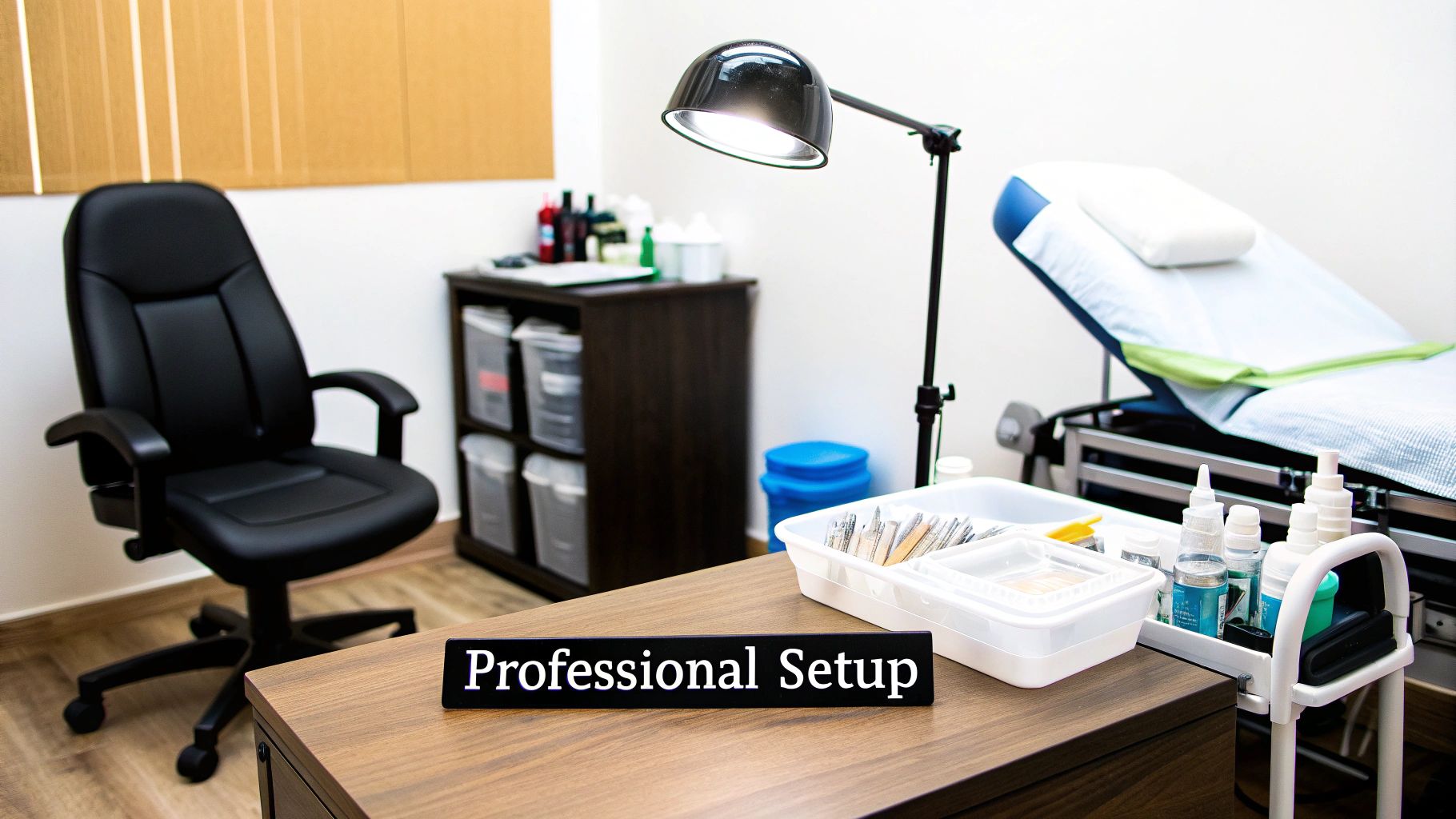
Your workspace has to be built around sterility and comfort. This means a dedicated treatment area that’s easy to sanitise, excellent lighting so you can see every detail, and a comfortable chair or bed for your client. You’ll also need a serious stock of disposables.
To get you started, here is a rundown of the absolute essentials you'll need to set up your practice.
Essential SMP Startup Equipment Checklist
This table breaks down the core equipment and supplies every new SMP artist needs to get started on the right foot.
| Item Category | Specific Examples | Importance Level |
|---|---|---|
| Treatment Furniture | Adjustable client chair/bed, artist's stool, trolley for supplies | High |
| Lighting | Bright, adjustable LED lamp (a magnifying lamp is a huge plus) | High |
| Hygiene & Safety | Autoclave (or use pre-sterilised disposables), sharps container, hospital-grade surface disinfectant, gloves, barrier film, machine bags | Critical |
| Disposable Supplies | Sterile single-use needles, ink cups, bibs, cotton rounds, alcohol swabs | Critical |
| Client Care | Numbing cream (optional), aftercare products, client consent forms | High |
Investing in this professional setup and maintaining impeccable hygiene doesn't just meet legal requirements; it builds trust. It shows your clients you're a serious professional dedicated to giving them a safe, positive experience, which is the bedrock of any successful SMP business.
Building Your SMP Business and Client Base
Finishing your training is a massive achievement, but honestly, it’s just the starting block. The real race begins now. Your focus has to pivot from perfecting your technique to actually building a business that pays the bills. This is where you convert all that training into a real career by getting clients through the door and earning a top-notch reputation, especially in a competitive market like Western Australia.

It’s a classic catch-22 that trips up so many new artists. They think they need a full client list before they can build a solid portfolio, but it’s completely the other way around. A killer portfolio is your single most powerful marketing tool, and you can start putting one together from day one.
Creating a Killer Portfolio from Scratch
When you’re fresh out of training, you won’t have a backlog of paying clients to show off. And that's totally okay. The trick is to get resourceful and create your own opportunities to prove what you can do.
Here's how you can build an impressive portfolio before your schedule is packed out:
- Offer a hefty discount to your first handful of clients. In return, you get their permission to use their photos and testimonials for your marketing. Just be upfront about it – they’re helping you, and you’re giving them a great deal.
- Work on friends or family members who are good candidates for SMP. This is a brilliant way to produce amazing work in a low-pressure setting.
- Document absolutely everything. I mean it. Take high-resolution photos and videos from every angle, using consistent lighting. You'll want shots before the first session, immediately after, and once everything has healed and settled.
Your main goal is to show prospective clients the incredible transformations you're capable of. Nothing sells your skill better than undeniable visual proof. For a bit of inspiration, check out a professional gallery of scalp micropigmentation before and after results. This will give you a benchmark for the quality and consistency you should be aiming for.
Smart Pricing for the WA Market
Figuring out your pricing can feel like walking a tightrope. Go too high, and you might scare people off. Go too low, and you devalue your own work and attract clients who only care about the cheapest price. You’re looking for that sweet spot: a price that honours your skill, covers your overheads, and fits within the local market here in WA.
Do your homework. See what other reputable artists in Perth and across Western Australia are charging. Don't just copy their numbers, but get a feel for the going rate. Your initial pricing might sit on the lower end as a portfolio-building strategy, but it should still look professional.
A big tip: avoid hourly rates. It’s much better to price based on the Norwood Scale for male pattern baldness or the Ludwig Scale for female hair loss. This gives your clients a clear, all-in cost right from the start.
Remember, you're not just selling a procedure; you're selling confidence. It's a life-changing result, and your pricing needs to reflect that immense value.
Marketing Your SMP Services Effectively
Alright, you've got a growing portfolio and a solid pricing structure. Now you need to make some noise. In this day and age, a strong online presence is non-negotiable. For a visual service like SMP, social media platforms like Instagram and Facebook are absolute gold.
Your content should be all about your results. Post those amazing before-and-afters, share video testimonials, and create helpful content that answers common questions people have about SMP. This establishes you as a credible expert they can trust. For anyone thinking bigger and aiming to open their own clinic, it helps to understand the whole entrepreneurial journey. This guide on how to launch a successful beauty business in Australia offers some great broader insights.
Mastering the Client Consultation
The consultation is where the magic happens. It's your moment to turn a curious enquiry into a booked client. This is your chance to build rapport, set realistic expectations, and showcase your professionalism. It’s so much more than a sales pitch.
During every consultation, you should:
- Listen Actively: Take the time to understand their hair loss story and what they truly hope to get out of the treatment.
- Educate Thoroughly: Walk them through the entire SMP process, from the first session to the long-term aftercare. No surprises.
- Design the Hairline: This is crucial. Use a wax pencil to draw a potential hairline right on their scalp. It helps them see the vision and allows you to work together to create a look they’ll love.
- Be Honest: Not everyone is an ideal candidate. You have to be prepared to say "no" if someone's expectations are out of line or if they have a scalp condition that needs a doctor's attention first.
Building a successful business is a marathon, not a sprint. If you focus on creating a stunning portfolio, pricing yourself intelligently, marketing with purpose, and mastering the client consultation, you'll be laying the groundwork for a long and rewarding career in scalp micropigmentation.
Got Questions About SMP Training? We’ve Got Answers
Stepping into the world of scalp micropigmentation is a big decision, and it’s completely normal to have a long list of questions. It's a significant career move, after all. Let's tackle some of the most common things aspiring artists ask, so you can feel confident about your next steps.
A popular one right off the bat: "Do I need a background in tattooing or beauty?" The simple answer is no. While that kind of experience can give you a bit of a head start, it’s absolutely not a deal-breaker. Some of the most talented SMP artists I know came from backgrounds like construction or office work. What really counts is a steady hand, a sharp eye for detail, and a real passion for changing lives.
Any good training course is built to take you from zero to hero, teaching you everything you need to know from the ground up.
How Long Does It Take to Learn SMP?
This is the big one, isn't it? Everyone wants to know the timeline. A quality, in-person training course here in Australia typically involves an intensive 3 to 5 days of hands-on learning.
But let’s be clear: that’s just the beginning of your journey. The real skill is built through practice, practice, and more practice. Once you’ve completed your initial course, you should be prepared to dedicate at least 100 to 150 hours to honing your craft. This means hours spent working on practice skins, melons, and eventually, live models to really lock in that muscle memory. Most artists start to feel genuinely confident in their work after they’ve completed their first 10 to 15 full client treatments.
Your initial training doesn’t make you an expert overnight. Its purpose is to arm you with the solid foundational skills and safety knowledge you need to start practising safely. True artistry and efficiency come with time and dedication.
What’s the Toughest Part for a New Artist?
Mastering pigment depth. Without a doubt, this is the biggest hurdle for almost every new artist. We're talking about a game of micromillimetres here.
If your needle is too shallow, the pigment will just fade away in a few weeks. Go too deep, and you risk the pigment spreading into a blurry mess known as a "blowout"—the exact opposite of the crisp, natural follicle replication you’re aiming for.
Getting that depth just right, consistently, across an entire scalp where the skin thickness is constantly changing... that takes an incredible amount of practice and feel. This is precisely why hands-on, in-person training is so crucial. A good instructor can literally watch your hand pressure and correct your technique on the spot—something a pre-recorded video can never do.
A few other common challenges you'll face include:
- Hairline Design: It's an art form in itself. You have to learn how to create soft, natural hairlines that are not only age-appropriate but also perfectly frame your client's face.
- Colour Matching: This involves more than just looking at hair colour. You need to accurately read a client's skin undertones to select a pigment that heals to a perfect, neutral shade, not one that turns blue or ashy.
- Managing Client Nerves: Your client is putting a lot of trust in you. A huge part of the job is learning how to keep them calm, comfortable, and confident throughout the entire process.
Pushing through these challenges is what separates the good artists from the great ones. Every single practitioner has been there. Consistent, focused practice is your ticket to creating the kind of incredible results that will build your reputation and your business.
At My Transformation, we’re committed to offering the highest standard of SMP training in Western Australia. We provide the skills, confidence, and ongoing support you need to build a thriving career. Find out more by exploring our scalp micropigmentation training courses.