
Receding Hairline Treatment A Guide to Modern Solutions
Deciding on the best way to tackle a receding hairline isn't a one-size-fits-all situation. The right path for you really comes down to your personal goals. Are you looking to slow down the thinning process and hold onto what you have? Or are you aiming to restore the look of a full, sharp hairline?
Some solutions, like topical Minoxidil, are all about preserving the hair you've got. On the other hand, a cosmetic procedure like Scalp Micropigmentation (SMP) offers a guaranteed and permanent way to create the illusion of density, giving you back that defined hairline for good.
Navigating Your Receding Hairline Treatment Options
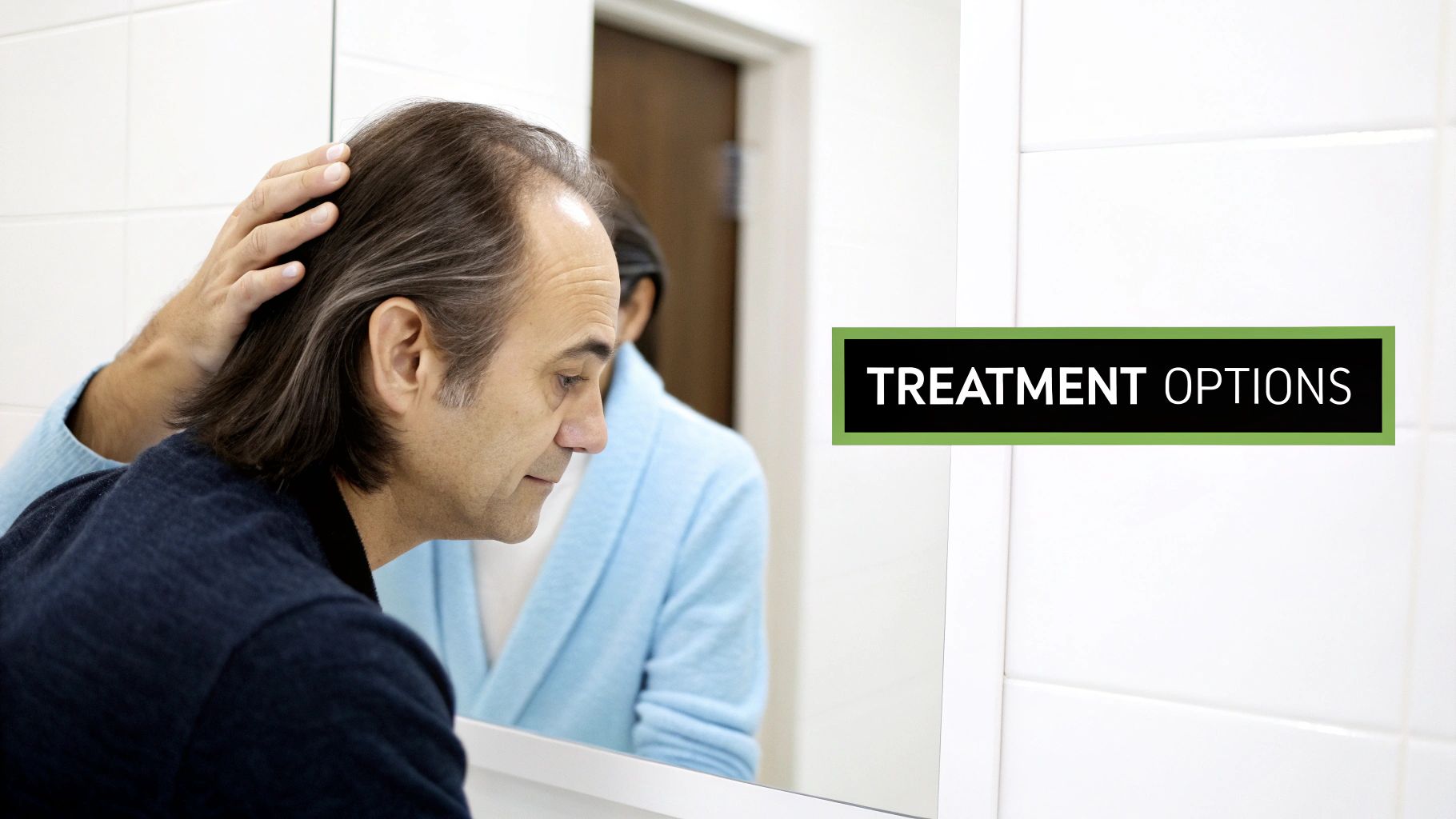
Catching that first glimpse of a receding hairline in the mirror can be a bit of a shock, but the good news is there are more effective and accessible treatments available today than ever before. For most people, the culprit is androgenetic alopecia—better known as male or female pattern baldness. Getting a handle on what causes a receding hairline is a great first step toward finding a solution that actually works.
If you feel like you're the only one dealing with this, you're definitely not alone. Here in Australia, a staggering 40.8% of men are affected by some degree of baldness, giving us one of the highest rates in the world. This has naturally created a huge demand for real solutions. In fact, the Australian hair loss treatment market hit USD 133.84 million in 2024 and is expected to climb to an incredible USD 302.61 million by 2033, which just goes to show how much confidence people have in modern treatments.
A First Look at Treatment Categories
To make sense of it all, it helps to break the options down into a few main groups. Each one tackles hair loss from a different angle, so there’s something to suit different needs, budgets, and lifestyles.
- Medical Treatments: These are your pharmaceutical-grade options, like Minoxidil and Finasteride. Their main job is to put the brakes on hair loss and, in some cases, encourage a bit of regrowth.
- Regenerative Therapies: This group includes treatments like Platelet-Rich Plasma (PRP), which cleverly uses your body's own healing powers to give struggling hair follicles a boost.
- Surgical Restoration: The most famous player here is the hair transplant. This procedure involves physically moving healthy hair follicles from a dense area (like the back of your head) to the thinning hairline.
- Cosmetic Solutions: This is where non-invasive techniques like Scalp Micropigmentation (SMP) come in. SMP creates a hyper-realistic illusion of a full head of hair by tattooing thousands of tiny pigment dots onto the scalp.
While weighing up these modern solutions, many people also look into how to regrow your hairline naturally with diet and lifestyle changes. Before we get into the nitty-gritty of each option, here’s a quick summary table to give you a clear overview.
At-a-Glance Guide to Receding Hairline Treatments
This table offers a quick snapshot of the main treatment options, how they work, and who they’re generally best for. Think of it as your starting point before we dive into a more detailed analysis of each one.
| Treatment Type | Mechanism of Action | Ideal Candidate | Outcome Type |
|---|---|---|---|
| Medical | Blocks DHT or stimulates blood flow to follicles. | Early-stage hair loss, aiming for preservation. | Halts loss, potential for minor regrowth. |
| Surgical | Physically relocates healthy hair follicles. | Sufficient donor hair, seeking actual hair growth. | Permanent hair growth (variable density). |
| Cosmetic (SMP) | Deposits pigment to replicate hair follicles. | Any stage of hair loss, wants guaranteed density. | Permanent illusion of a full hairline. |
| Regenerative | Uses growth factors to stimulate weak follicles. | Thinning hair, wants to improve hair thickness. | Improved hair health and density. |
With this foundation, you can start to see which category might align best with your expectations and the current stage of your hair loss.
A Realistic Look at Medical Treatments: Minoxidil and Finasteride
When you start researching ways to tackle a receding hairline, Minoxidil and Finasteride are almost always the first names that pop up. These are the go-to medical-grade options, and for good reason—they're the frontline defence for countless guys trying to stop hair loss in its tracks. But picking one isn't a simple choice; it’s about figuring out what truly fits your life and your expectations.
Forget a basic pros and cons list. The real decision often comes down to your daily routine. Minoxidil (you've probably heard of the brand Rogaine) is a topical foam or liquid you apply directly to your scalp, usually twice a day. On the other hand, Finasteride (Propecia) is a simple pill you take once a day. The key difference is how they're used: one is a hands-on, local treatment, while the other works systemically throughout your body.
This is a bigger deal than it sounds. Are you genuinely prepared to commit to a twice-daily scalp application? It can be a bit greasy and needs time to dry. Or does the "pop a pill and forget it" approach feel more sustainable for you? Being honest about this simple, practical question is often the biggest predictor of whether you'll stick with it long enough to see results. To get a better handle on what's out there, it's worth exploring the full range of topical treatments for men's hair loss.
Commitment and Realistic Timelines
Let's be clear: both Minoxidil and Finasteride require serious, long-term commitment. They aren't a quick fix or a cure; think of them as an ongoing maintenance plan for your hair. You won't see results overnight. It generally takes a consistent three to six months before you might notice any real difference, like less hair in the shower drain or some fine, new hairs starting to appear.
And here’s the most important part: any ground you gain is completely dependent on you continuing the treatment. If you stop, the hair loss cycle kicks back in, and any hair you saved or regrew will likely be gone within a few months. This turns the choice into a significant lifestyle decision. You're signing up for a daily routine for as long as you want to keep the results.
Key Takeaway: Medical treatments are a maintenance strategy, not a cure. Their main job is to help you keep the hair you've got and maybe achieve some modest regrowth. They won't magically restore a hairline that has already receded significantly.
Understanding Effectiveness and Limitations
Setting realistic goals is crucial when it comes to these medications. Finasteride gets to the root of the problem by blocking DHT, the hormone primarily responsible for male pattern baldness. Minoxidil’s exact mechanism isn't fully understood, but it's believed to improve blood flow to the hair follicles, encouraging them to stay in their growth phase.
Studies have proven that both can be effective at slowing down hair loss. In fact, one study found that 94% of men saw improvement when using both Minoxidil and Finasteride together. However, their real strength lies in preservation, especially around the crown and mid-scalp areas. They are far less effective at regrowing a dense head of hair on a completely slick, bald frontal hairline.
Because of this, they are best suited for guys in the earlier stages of hair loss who are focused on holding the line. If your main objective is to rebuild a sharp, strong hairline that's already well on its way back, these treatments on their own probably won't get you there. To see how these medical options fit within a complete strategy, take a look at our comprehensive guide to hair loss solutions for men.
Regenerative vs. Light-Based Therapies: A Closer Look
Moving beyond daily pills and potions, we get into some seriously interesting non-surgical territory: Platelet-Rich Plasma (PRP) and Low-Level Laser Therapy (LLLT). Both are getting a lot of buzz for treating a receding hairline, and for good reason. They work by encouraging your body to do what it does best—heal and grow. But they get there in completely different ways, and knowing the difference is crucial.
Think of PRP therapy as a supercharged boost of your body’s own healing power. We take a small sample of your blood, spin it in a centrifuge to separate and concentrate the platelet-rich plasma, and then inject this liquid gold—packed with growth factors—right back into your scalp. The whole idea is to jolt dormant hair follicles back to life and give your existing hair a much-needed health kick.
LLLT, on the other hand, is totally non-invasive. This approach uses specific wavelengths of low-level laser light, which your scalp absorbs. The energy from the light is thought to fire up the cells in your follicles, improving blood flow and encouraging them to stay in their growth phase for longer. The result? Hairs that grow thicker and stronger.
The Patient Journey: PRP vs. LLLT
What’s it actually like to undergo these treatments? The experiences couldn't be more different.
A PRP session is an in-clinic procedure. You’ll be in the chair for about an hour for the blood draw and a series of small injections across your scalp. We’ll usually use a topical anaesthetic to keep you comfortable. Most people start with a series of treatments, typically one a month for a few months, before switching to maintenance sessions every six to twelve months to keep the results going.
LLLT is usually a do-it-yourself job at home. You can buy caps, headbands, or even combs that you use for a short period several times a week. It’s convenient, for sure, but it demands consistency. If you’re not disciplined enough to stick to the schedule, you just won’t see the results.
So, you’re looking at a classic trade-off: PRP is an intensive, professionally administered treatment you get done periodically, while LLLT is a less invasive but constant, long-term commitment you manage yourself.
Down Under, the appetite for advanced hair restoration is exploding. The Aussie market pulled in USD 86.7 million in 2023 and is forecast to soar to USD 257.3 million by 2030. What’s leading the pack? PRP therapy. It snagged a massive 38.06% revenue share in 2023, making it the fastest-growing player in the game. You can dig into the numbers on the growth of Australia's hair restoration market.
Cost, Frequency, and What to Realistically Expect
When it comes to the financial side, you need to think about the long game.
- PRP Therapy: Here in Australia, a single session will typically set you back several hundred dollars. With an initial round of three or four treatments and then biannual top-ups, the first year can be a significant investment.
- LLLT Devices: A good, clinically-proven at-home device has a one-off cost that can be anywhere from a few hundred to a couple of thousand dollars. But once you’ve bought it, that’s it—no ongoing fees.
So, what can you actually expect? Both treatments are aiming for the same thing: slowing down hair loss and beefing up the hair you still have. They are not about resurrecting a long-gone hairline. Studies have shown that many people notice less shedding and an increase in the diameter of their hair shafts, which all adds up to a fuller look.
But let’s be clear: neither of these is a permanent cure. They’re fantastic supporting acts, especially if you’re dealing with diffuse thinning or are in the early stages of recession. Think of them as preservation and enhancement tools—a vital part of a wider strategy, but not a silver bullet for advanced hair loss.
Choosing Between a Hair Transplant and Scalp Micropigmentation
When you get serious about tackling a receding hairline, the conversation almost always boils down to two heavy hitters: the surgical solution of a hair transplant or the cosmetic artistry of Scalp Micropigmentation (SMP). Picking the right one isn’t about which is "better" in a general sense. It’s about which is unequivocally better for you—your unique hair loss pattern, your lifestyle, and what you want to see in the mirror.
A hair transplant is a medical procedure, plain and simple. It involves surgically moving healthy hair follicles from a dense donor area (usually the back of your head) to the balding spots up front. The end goal is to grow real, tangible hair. SMP, on the other hand, is a highly advanced cosmetic tattoo. Using specialised pigments and microneedles, an artist meticulously replicates the look of thousands of individual hair follicles, creating a flawless illusion of a full head of hair cut very short.
So, one restores actual hair, while the other restores the appearance of hair. This decision tree can help you visualise where each treatment fits.
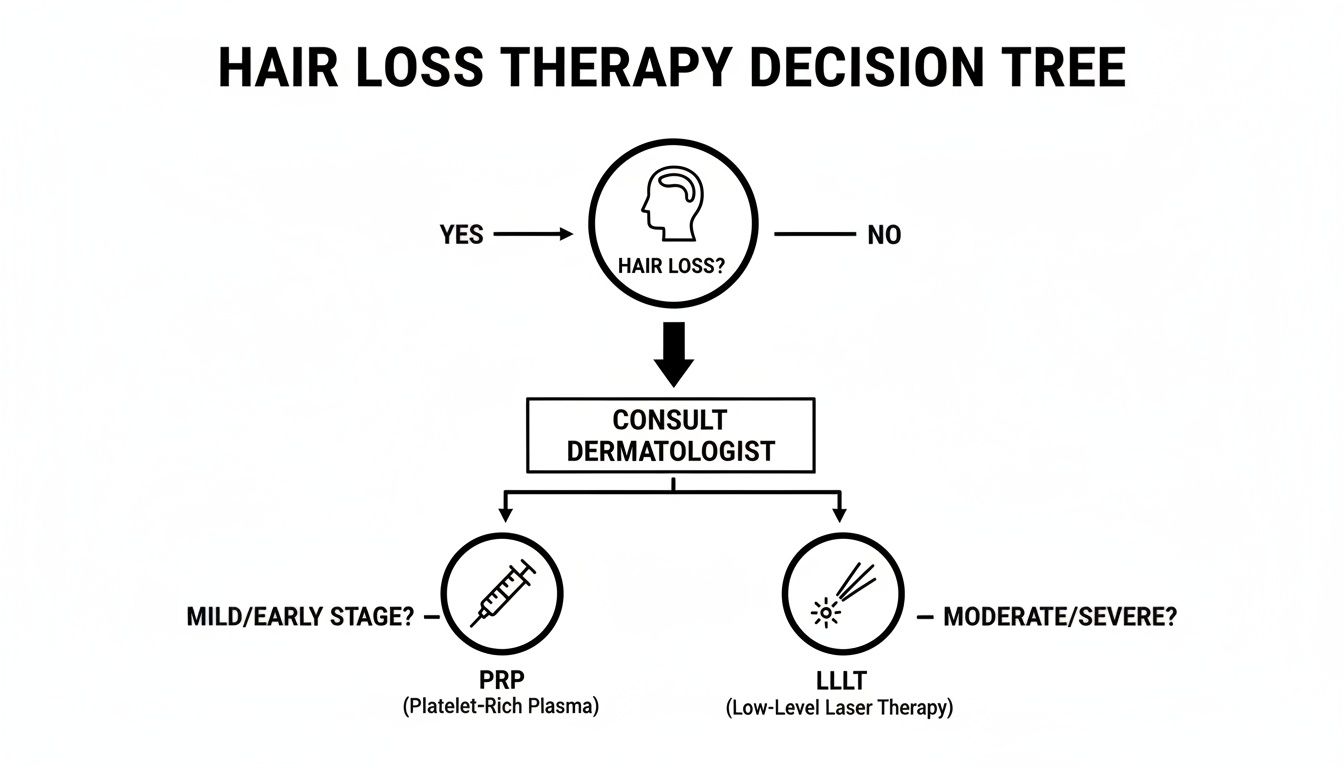
As you can see, the path you take hinges on whether you're looking to stimulate what you have or create an entirely new cosmetic look.
To help you decide, we've broken down the key differences between these two leading solutions in a head-to-head comparison.
Hair Transplant vs SMP: A Situational Decision Guide
This table gets right to the point, comparing the most important factors you'll need to consider—from who makes a good candidate to what you can expect in terms of cost and final results. It's designed to help you see which option aligns best with your specific circumstances.
| Decision Factor | Hair Transplant (FUE/FUT) | Scalp Micropigmentation (SMP) |
|---|---|---|
| Best For | Men with moderate, stable hair loss and a strong, dense donor area at the back/sides of the head. Ideal for those who want to grow and style longer hair. | Men at any stage of hair loss, from mild recession to full baldness. The perfect solution for poor transplant candidates, those with scars, or men who prefer a sharp, buzzed look. |
| Core Process | A surgical procedure. Follicles are harvested from a donor site and surgically implanted into the thinning areas. Involves local anaesthesia and incisions. | A non-surgical cosmetic tattoo. Tiny pigment deposits are meticulously placed into the scalp's upper dermis to replicate the appearance of hair follicles. |
| Recovery Time | 1-2 weeks of initial downtime. Scabbing, swelling, and redness are common. Strenuous activity must be avoided for several weeks to protect the new grafts. | Minimal downtime. You can typically return to work the next day. Some minor redness may persist for 24-48 hours. |
| Time to See Results | 12-18 months. It's a long waiting game as the transplanted follicles shed and then slowly begin to regrow. The final result isn't visible for over a year. | Immediate. The effect is visible after the very first session, with the full, finished look achieved after the final session (2-4 sessions total). |
| Result Certainty | Variable. Success depends on the survival rate of the grafts (70% to 90%), the surgeon's skill, and how your body heals. The final density is not guaranteed. | Guaranteed. The result is predictable and consistent. You see exactly what you’re getting as the treatment progresses. |
| Typical Cost (AU) | Significant investment: $5,000 to over $30,000, priced per graft. Further procedures may be needed down the line. | More accessible: $1,500 to $5,000 for a complete treatment plan. Minor touch-ups may be needed every 4-6 years. |
| Pain Level | Moderate discomfort managed with local anaesthetic. The recovery period can be uncomfortable. | Minimal discomfort, often rated a 2-4 out of 10. A topical numbing agent can be used if needed. |
Ultimately, choosing between a hair transplant and SMP is a deeply personal decision that comes down to your hair loss reality and your aesthetic goals.
The Make-or-Break Factor: Candidacy
Your suitability for either procedure is the first and most important hurdle. This is where the two paths often diverge sharply.
A hair transplant has one non-negotiable requirement: a healthy, plentiful supply of donor hair. If your hair loss is extensive and has crept down the back and sides of your head, you simply won't have enough follicles to harvest for a dense result up top. Men with advanced balding (think Stages 6-7 on the Norwood scale), diffuse thinning all over, or conditions like alopecia areata are often not viable candidates.
This is exactly where SMP shines. Candidacy for SMP is almost universal. Because it doesn't rely on donor hair, it’s the go-to solution for anyone who isn't a good fit for a transplant. It works for every stage of hair loss, from the first signs of recession to complete baldness, and on all skin types and tones.
Outcome Certainty and Your Final Look
Here’s where the difference becomes crystal clear. A hair transplant has an element of unpredictability. The survival rate of transplanted grafts can range from 70% to over 90%, but it’s never a sure thing. Then comes the 12-18 month wait to see the final density—an anxious period of hoping for the best.
The Key Differentiator: Scalp Micropigmentation delivers a guaranteed result from the very first session. The illusion of density is immediate and predictable. There’s no waiting and no hoping for follicles to take hold; you walk out of the clinic with a restored hairline.
The final look is also fundamentally different. A successful transplant gives you real hair you can grow and style, but it might not have the fullness you remember. SMP, on the other hand, creates the perfect illusion of a full head of hair with a clean, buzzed-down style. It’s unbeatable for crafting sharp hairlines and adding the appearance of density to thinning hair, and can even be used to brilliantly camouflage scars from old FUT transplant procedures.
To dig deeper into how these two treatments stack up, you can learn more about what truly separates SMP from hair transplants and why they are often used together.
Finding Your Ideal Solution in Western Australia

Choosing the right path to tackle a receding hairline can feel like a maze. But the best way to cut through the noise is to ask yourself one straightforward question: what result am I really after? Your answer—whether it's simply slowing down hair loss, hoping for some regrowth, or getting a guaranteed sharp hairline—is your compass.
Here in Western Australia, you're not short on world-class options. The right fit for you will hinge on how far your hair loss has progressed, what you're willing to spend, and what kind of commitment you can make. Are you prepared for a daily medical routine, a major surgical procedure, or do you want a cosmetic fix that delivers right away?
For a lot of people, the clear winner is a solution that’s predictable, permanent, and doesn’t add any fuss to their daily life. This is where Scalp Micropigmentation (SMP) really shines.
Why SMP Is a Game-Changer
Scalp Micropigmentation isn't a medical treatment; it's a highly advanced cosmetic tattoo that meticulously replicates the look of individual hair follicles. The result is a flawless illusion of a full head of hair with a clean, modern buzz cut. While medications are about maintenance and transplants come with no guarantees, SMP gives you a definite, visible outcome from day one.
At My Transformation, this is our specialty. We've dedicated ourselves to mastering this art form because we've seen how much a receding hairline can knock a person's confidence. Our focus is helping men and women across WA find a solution that just works. We stick exclusively to SMP because we know it delivers immediate, life-changing results without the need for surgery or ongoing medication.
With over 50% of Australian men experiencing hair loss, the hunt for effective treatments is only growing. The wider alopecia market is forecast to grow by 6.48% CAGR from 2021-2026, driven by rising awareness of solutions like SMP. My Transformation is at the forefront of this shift in WA, providing expert SMP for everything from full hair loss to adding density for women. You can dig deeper into the Australian alopecia treatment market report for more data.
The Perfect Fit for the West Australian Lifestyle
Let's face it, the active, sun-and-surf lifestyle we love in WA calls for solutions that are low-maintenance and high-impact. SMP is practically designed for it. Once your sessions are complete and healed, there's zero daily upkeep.
- No daily creams or pills: You can forget the ongoing hassle and cost of medications.
- Completely sweat-proof and waterproof: Hit Cottesloe Beach or go for a run along the Swan River without a second thought.
- A sharp, clean look 24/7: Just wake up and go. Your hairline is already perfect.
This "get up and go" freedom is something other treatments can't match. A hair transplant involves weeks of careful recovery, and medications lock you into a strict daily schedule. SMP hands you back your time and peace of mind.
At My Transformation, we believe your hair loss solution shouldn't define your routine; it should empower your lifestyle. SMP provides that freedom by delivering a permanent, aesthetic result that looks great from day one and requires no ongoing effort.
My Transformation: Your Local SMP Expert
When you're looking into a treatment like this, local expertise is everything. You want someone who is part of your community and is committed to giving you exceptional, personalised care. My Transformation is a dedicated Western Australian clinic, owned and operated with a singular focus: helping you get the look you want through artistry and professionalism.
We specialise in creating ultra-realistic hairlines that are custom-designed for your facial structure, age, and personal style. We’re not a jack-of-all-trades clinic that adds SMP to a long list of services—it’s our craft and our passion. That specialisation means you get an unmatched level of skill and attention to detail.
If you’re after a guaranteed, immediate, and permanent fix that fits seamlessly into an active life, SMP is the standout choice. It cuts out the guesswork and the waiting game. Find out more about how we're helping people across the state in our guide to SMP in WA and see if this is the right path for you.
Answering Your Questions About Receding Hairline Treatments
Diving into the world of hairline treatments can feel a bit overwhelming, and it's natural to have questions. To help you feel more confident about your next steps, I've answered some of the most common queries we get from clients, cutting through the noise with clear, practical advice.
How Do I Choose the Best Treatment for Me?
The honest answer? It really depends on you. The best choice always comes down to your specific situation, mainly your level of hair loss, your budget, and the final look you're after.
If you're dealing with significant hair loss, want that guaranteed sharp hairline, or just prefer a clean, shaved-down style, Scalp Micropigmentation (SMP) is almost always a standout choice. On the other hand, if you're just starting to notice thinning and your goal is to hold onto the hair you have, medical options like Finasteride or regenerative therapies like PRP might be a better fit. A hair transplant is a serious commitment, best suited for those who have enough healthy donor hair and are set on growing their own hair back.
Your best first move is always a professional consultation to get a clear picture of what's right for you.
Is Scalp Micropigmentation Painful and Is It Permanent?
Most of our clients find the sensation to be more of a minor annoyance than actual pain, typically rating it a 2-4 out of 10 on the discomfort scale. We use a top-quality topical numbing agent to make sure you're comfortable from start to finish.
As for the results, they are considered permanent. Like any tattoo, the pigment can lighten just a fraction over a long period. But a quick and easy touch-up session every 4-6 years is all it takes to keep it looking sharp and fresh. It’s an incredibly low-maintenance, long-term fix.
Can I Combine Different Hair Loss Treatments?
Yes, and it’s often a brilliant strategy. Mixing treatments can deliver a much more comprehensive and natural-looking result. For example, many guys get SMP after a hair transplant to add visual density between the new grafts, making their hair appear significantly fuller. It's also fantastic for camouflaging old FUT transplant scars. If you want to dig deeper into this, you can learn more about combining SMP with medications like Minoxidil and Finasteride.
This hybrid approach delivers the best of both worlds: the texture of real hair from a transplant combined with the underlying fullness and guaranteed density that only SMP can provide.
Ready to restore your hairline with a solution that’s guaranteed, immediate, and permanent? At My Transformation, we specialise in creating world-class Scalp Micropigmentation results right here in Western Australia. Book your free, no-obligation consultation today and take the first step toward reclaiming your confidence.