
A Complete Guide to Low Density Hair Solutions in Australia
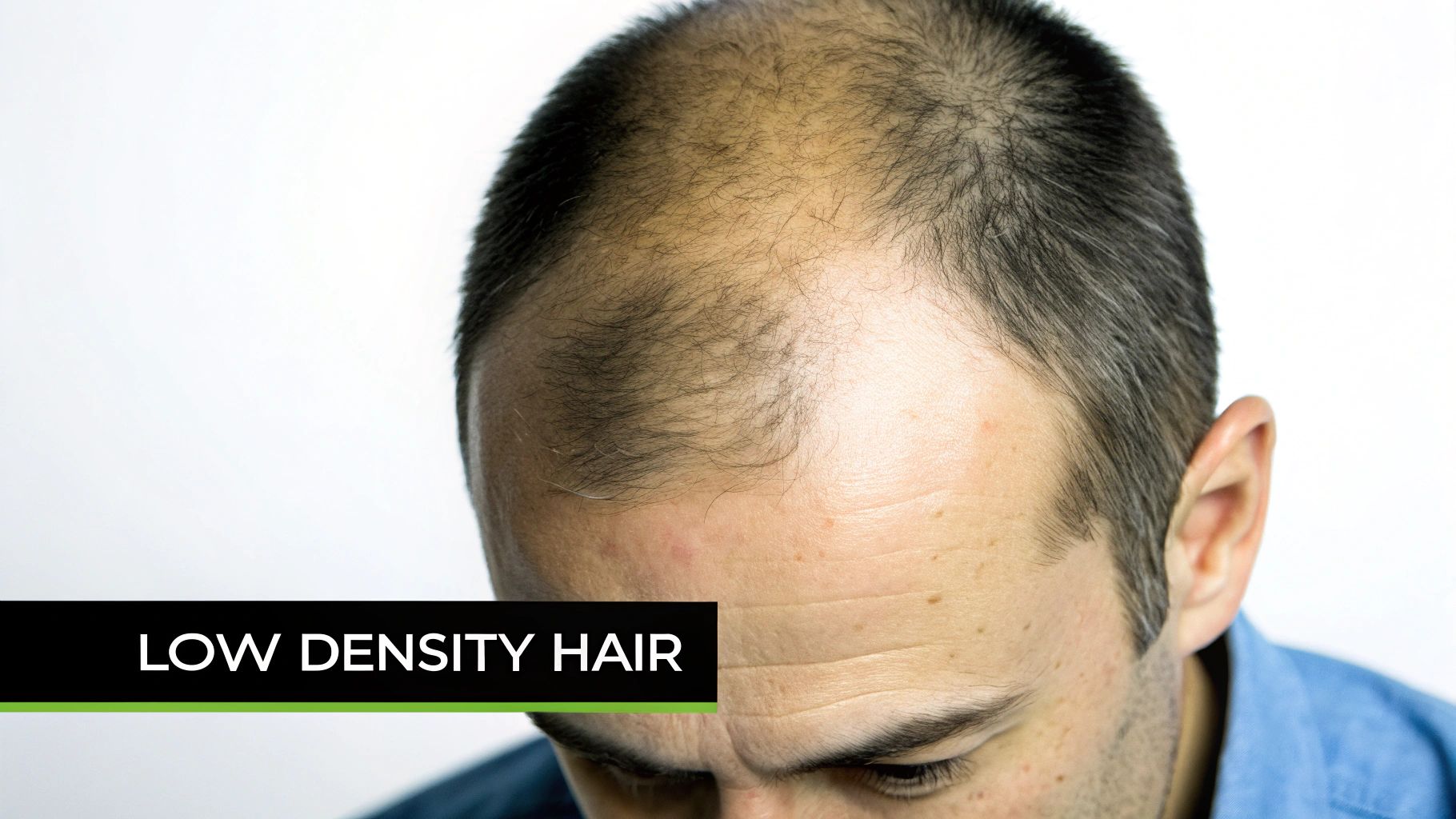
When people talk about thinning hair, they're often describing low density hair. But what does that actually mean?
It’s not about how thick or thin each individual strand of hair is. Instead, it’s about how many of those strands are packed into a certain area of your scalp. Imagine a healthy, thriving forest floor, thick with saplings. Now picture a forest that's been thinned out, with large gaps between the trees where you can easily see the ground. That’s the difference between high and low density hair.
The sparseness is what makes the scalp more visible and gives that overall look of thinning.
What Low Density Hair Really Means (And How It Affects You)
It’s a common mix-up, but "density" and "thickness" are two completely different hair characteristics. Getting this right is the first, most important step in finding a solution that actually works for you.
Here’s the simple breakdown:
- Hair Thickness: This is about the diameter of a single strand. Is your hair fine, medium, or coarse?
- Hair Density: This is about the number of hair strands on your head, typically counted per square centimetre.
You can have very fine hair strands but tons of them (high density), creating a look of incredible volume. On the flip side, you could have thick, coarse strands that are few and far between (low density), which can still make your scalp visible and your hair appear thin. For most people grappling with the appearance of hair loss, low density is the real culprit.
It’s Not Just About How It Looks
Let's be honest—living with low density hair is about more than what you see in the mirror. It can carry a real emotional weight, slowly eroding your self-esteem. The daily battle of trying to style thinning hair, worrying about how your scalp looks under bright office lights, or feeling on-edge in social settings… it's exhausting, and it’s a perfectly valid struggle.
This guide is designed to cut through all the noise and give you clear, practical information. We get the emotional side of it, and our goal is to show you that there are genuinely effective ways to manage the look of low density hair and get your confidence back. You’re definitely not alone.
While your baseline hair density is mostly down to genetics, things like ageing, hormonal shifts, and even lifestyle choices can cause it to decline. Each hair follicle produces a single strand, so when those follicles shrink or stop producing hair altogether, your overall density drops.
Finding a Modern Solution That Works
The best part? You don't just have to put up with thinning hair. Today’s solutions offer some brilliant ways to create the look of fullness and density. One of the most effective and immediate non-surgical options is Scalp Micropigmentation (SMP). It’s a highly specialised cosmetic tattoo that masterfully mimics the appearance of individual hair follicles on the scalp.
We’re here to guide you through everything, from the causes of low density hair to the practical solutions available right here in Western Australia. We’ll look at how to assess your own hair, compare your options, and dive into advanced techniques like SMP that can deliver a huge confidence boost, fast. Understanding the basics of the hair growth cycle is a great starting point, so let's get into it.
What's Behind Low Hair Density?
Noticing more scalp peeking through your hair can be a bit confronting. But understanding what’s causing it is the first real step you can take to address it. Low hair density isn't just something that happens out of the blue; it’s usually the result of a specific process tied to your genetics, hormones, and sometimes, your lifestyle.
For most of us, the reason can be traced back through our family tree.
If thinning hair is a common theme with your parents or grandparents, there's a good chance you’ve inherited that same tendency. This is what’s known as androgenetic alopecia—it's the single most common cause of hair loss across the globe and the engine behind both male and female pattern hair loss. The issue isn't that you're shedding hair at an alarming rate. Instead, it’s that your hair follicles have been genetically programmed to become sensitive to certain hormones as you get older.
This sensitivity triggers a process called miniaturisation, where the follicles literally shrink. As they get smaller, the hairs they produce become finer, shorter, and weaker. Over time, these follicles may stop producing hair altogether, which is when you start to see that noticeable drop in density.
The Role of Hormones in Thinning Hair
Hormones are the body’s powerful messengers, and when they're out of balance, your hair is often one of the first things to show it. When it comes to androgenetic alopecia, the main player is a hormone called dihydrotestosterone, or DHT.
DHT is derived from testosterone, and for people who are genetically susceptible, it attaches to receptors in the scalp's hair follicles. This kicks off that miniaturisation process, cutting the hair's growth phase short and gradually thinning out your overall coverage. This is especially true for men. To get a better handle on the specifics, you can take a deeper dive into what causes male pattern baldness.
For women, hormonal shifts are a major factor, particularly during big life events like pregnancy, the post-partum period, and menopause. The fluctuating levels of oestrogen and progesterone can throw the natural hair growth cycle into disarray, often leading to increased shedding and lower density.
Key Takeaway: The primary cause of low density hair for both men and women is a genetic sensitivity to hormones. This makes hair follicles shrink over time, producing thinner and thinner strands until they eventually give up, creating a sparse look.
Here in Australia, these conditions are incredibly common. Female pattern hair loss (FPHL) is the top reason for thinning hair among Australian women. Research from the Royal Australian College of General Practitioners reveals it affects up to 49% of women over their lifetime. With an age-adjusted prevalence of over 32% in adult women of European descent, it's estimated that more than 800,000 Australian women are currently dealing with moderate-to-severe FPHL. You can find out more about the research on female pattern hair loss to see the full picture.
How Lifestyle and Environment Play a Part
While your genes might load the gun, it's often external factors that pull the trigger and either speed up or worsen thinning hair. Living in Australia comes with its own set of environmental pressures that can definitely affect your hair's health.
-
Significant UV Exposure: We all know what the Aussie sun can do to our skin, but it can also damage our hair. Too much UV exposure degrades the protein structure of the hair strands, leaving them brittle and weak. It can also create oxidative stress on the scalp, which isn't great for follicle health.
-
High-Stress Environments: It’s no secret that chronic stress is bad for us, and it’s a well-known contributor to hair loss. Stress can shock a large number of follicles into a resting phase all at once, leading to a sudden, noticeable shed a few months down the track. This is known as telogen effluvium.
-
Nutritional Deficiencies: Your hair follicles are like tiny factories that need a constant supply of raw materials to function properly. If you’re low on key nutrients like iron, zinc, vitamin D, or B vitamins, hair production can slow right down, contributing to thinning.
These factors don't usually cause androgenetic alopecia by themselves, but they can absolutely pour fuel on the fire and make the visible signs of thinning appear sooner and more aggressively. Pinpointing these triggers is a key part of putting together a smart, well-rounded plan to manage your hair density.
How to Check Your Hair Density at Home
You don’t need to be a trichologist to get a first impression of your hair density. In fact, some of the most effective checks can be done right in your own bathroom mirror.
Becoming a better observer of your own hair is the first step. It helps you notice subtle changes early on, turning a vague worry into a clear picture of what's happening. The goal isn’t to cause alarm, but to empower you with knowledge.
The Scalp Visibility Test
This is probably the most direct way to gauge your hair density. All you need is clean, dry hair and a room with good, direct overhead lighting.
Simply stand under the light and look at your reflection. Without parting your hair, how much of your scalp can you see? If the skin is quite visible through the strands, that's a classic sign of lower density. It’s even more telling if you can compare it to photos of yourself from a few years back.
The Part Line Test
Here’s another incredibly simple but revealing method. Comb a part into your hair as you normally would and take a good, hard look.
Does the part itself seem wider than it used to? A widening part is often one of the first things people notice. For women, this can sometimes create what's known as a "Christmas tree" pattern at the crown. For men, understanding these patterns is also key; you can learn more about the Norwood scale to see how different stages of hair loss are classified.
What Your Findings Mean: Seeing a bit more scalp or a wider part doesn't automatically mean you're experiencing major hair loss. Think of it as a single data point. The real insight comes from tracking these changes over time to see if they're progressing.
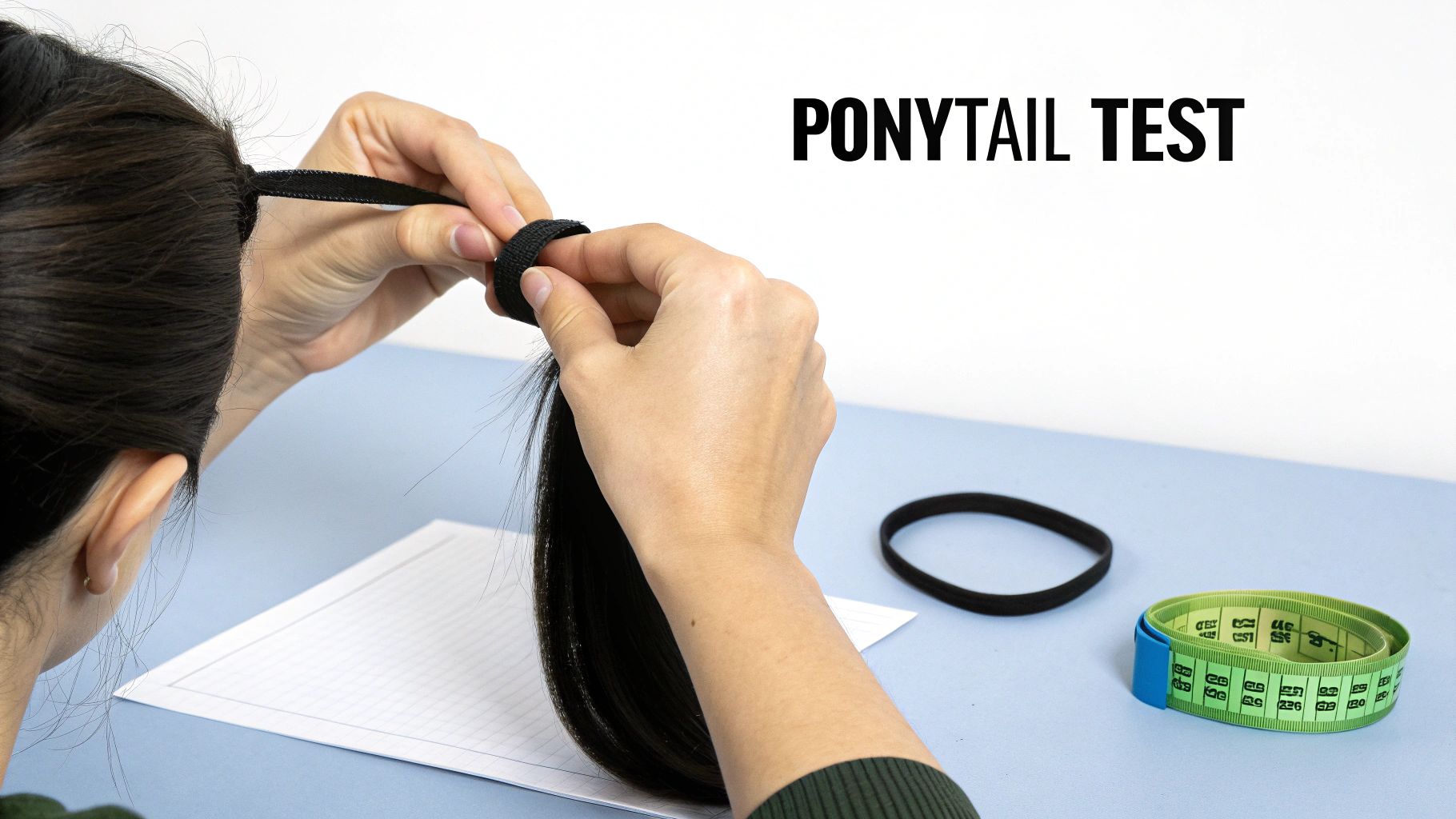
The Ponytail Test
If you have longer hair, this is a fantastic, tangible way to measure changes in overall volume, which is a direct reflection of density.
It’s as easy as it sounds:
- Gather Your Hair: Pull all your hair back into a low ponytail at the nape of your neck.
- Secure It: Use a standard hair tie.
- Measure the Circumference: You can wrap a flexible measuring tape around the base of the ponytail. Or, more simply, just notice how many times you have to wrap the elastic to get a secure hold.
A ponytail with a circumference of less than five centimetres is generally considered to be on the lower end of the density scale. But the real power of this test is in repetition. Try it every few months. If you find yourself needing an extra loop of the hair tie to make it feel snug, that's a very clear signal that your hair's total volume has decreased.
To help you keep track, here's a simple checklist you can use.
Hair Density Self-Assessment Checklist
Keeping a simple log of your observations can help you identify genuine trends instead of relying on memory. Just jot down what you see every month or two.
| Assessment Method | What to Look For | Frequency of Check |
|---|---|---|
| Scalp Visibility Test | Increased visibility of scalp under direct light | Monthly |
| Part Line Test | Widening of your natural part line or other parts | Monthly |
| Ponytail Test | Decrease in ponytail circumference (e.g., needing an extra hair tie loop) | Every 2-3 months |
| General Observation | Increased hair shedding on pillow, in shower, or on clothes | Ongoing |
Consistent tracking like this removes the guesswork. It gives you concrete information to bring to a professional if you decide it's time to seek expert advice.
Creating the Illusion of Density with Scalp Micropigmentation
When you're dealing with low-density hair, the biggest visual giveaway is the contrast between your hair and the skin of your scalp. While some treatments aim to grow more hair over time, what if you need a solution that works right now? Something non-surgical and reliable that creates the look of fullness instantly.
This is exactly where a brilliant cosmetic procedure called Scalp Micropigmentation, or SMP, comes into play.
Think of it like an artist meticulously stippling a drawing, building up a detailed image from thousands of tiny, individual dots. SMP works on a very similar principle. A highly trained practitioner uses specialised equipment to place thousands of minuscule pigment deposits into the upper dermis of your scalp.
Each tiny dot is precisely placed to mimic a natural hair follicle. When these impressions are layered by the thousands across thinning areas, they blend perfectly with your existing hair. The result? A powerful illusion of density that camouflages the scalp and brings back the appearance of a full head of hair.
How SMP Fills in the Gaps
It’s crucial to know that SMP is not just a standard tattoo. It uses completely different pigments, needles, and techniques designed specifically for the delicate skin on the scalp. It's a highly customised art form, tailored to match your exact hair colour, skin tone, and natural hairline.
For so many people, it's a genuine game-changer. Just think about these common scenarios where SMP truly shines:
- For Men with a Buzz Cut: If you rock a short, buzzed style but thinning is making it look patchy, SMP adds the perfect underlying shade to create the impression of a full, even buzz cut.
- For Women with a Widening Part: SMP can be carefully feathered along the part line, subtly darkening the scalp to make the part look narrower and your hair appear much fuller at the roots.
- Receding Hairlines or Thinning Crowns: The technique can rebuild a soft, natural-looking hairline or fill in that sparse patch on the crown, making your hair look substantially thicker from every angle.
The beauty of this approach is the immediate visual payoff, without waiting months for other treatments to maybe start working.
Scalp Micropigmentation doesn't grow hair—it creates the appearance of it. By reducing the scalp's visibility and mimicking the look of follicles, it provides a powerful, long-lasting cosmetic solution to the challenge of low density hair.
The Perfect Solution for Aussie Blokes
Here in Australia, male pattern baldness is incredibly common, making low-density hair a major concern for a lot of men. In fact, local research shows it’s responsible for over 90% of hair loss cases in Aussie men.
With studies finding that 50% of men are affected by age 50 and up to 80% by age 70, it’s no surprise that effective density solutions are so sought after. Australia's significant rate of male baldness, at 40.8%, ranks among the highest in the world, confirming why a visible scalp is such a common issue down under. You can discover more insights about hair loss trends in Australian men on plazacentralmedical.com.au.
SMP offers a direct, no-fuss answer to this problem. It camouflages thinning areas, restores the look of a stronger hairline, and gives the impression of thicker hair, which can be a massive confidence boost. It takes away that daily stress of worrying about how your hair looks under bright lights or from behind.
More Than Just a Hair Tattoo
It's really important to appreciate the level of artistry involved. A skilled SMP practitioner isn't just applying dots; they’re considering follicle direction, natural density variations, and how to create a soft, undetectable hairline that doesn't look artificial. When it's done right, the results are hyper-realistic.
The benefits speak for themselves:
- Immediate Results: You’ll walk out of your very first session seeing a noticeable difference.
- Non-Surgical: No incisions, no surgery, and practically no downtime.
- Long-Lasting: The results can last for years before a simple touch-up might be needed.
- Low Maintenance: Once the initial sessions are done, there’s no special daily routine to follow.
This technique has quickly become a go-to for anyone wanting a reliable and lasting fix for low-density hair. To really understand the process, check out our in-depth guide on what Scalp Micropigmentation is and see how it works from start to finish.
Comparing Your Hair Density Treatment Options
Trying to navigate the world of hair loss solutions can feel like a maze. With so many options out there—from daily medications and creams to major surgery—it's tough to know which path is right for you. To make a smart choice, you need a clear understanding of what each treatment really involves in terms of results, cost, and commitment.
Making an informed decision really comes down to weighing the pros and cons. Whether you're thinking about topical treatments, prescription pills, a hair transplant, or even a cosmetic solution like SMP, each one has its own unique set of benefits and potential downsides.
A Breakdown of Common Treatments
Let's cut through the noise and compare the most common options side-by-side. The reality is, low density hair is a huge concern for many of us here in Australia. A landmark study from Maryborough, Victoria, really drove this home, showing just how common androgenetic alopecia (AGA) is. The study found that 73.5% of men and 57% of women over 80 had noticeable hair loss in the middle of their scalp.
This kind of research really highlights the need for effective and accessible solutions. Let’s look at how the main treatments stack up.
Comparison of Low Density Hair Treatments
Here's a straightforward overview of the most common treatments for low density hair, comparing how they work, who they're best for, and what you can expect in terms of cost and results.
| Treatment Type | How It Works | Best For | Average Cost (AU) | Pros & Cons |
|---|---|---|---|---|
| Topical Minoxidil | A foam or liquid you apply directly to the scalp. It works by stimulating the hair follicles and keeping them in their growth phase for longer. | People in the early stages of hair loss or with general, widespread thinning. | $30 – $80 per month | Pro: Easy to get and use. Con: You have to use it every single day for life; results are often modest and can take months to show. |
| Oral Finasteride | A prescription-only pill that blocks DHT, the hormone that causes hair follicles to shrink and eventually stop growing. | Men experiencing classic male pattern baldness. | $40 – $70 per month | Pro: Can effectively slow down or even reverse thinning. Con: Potential for side effects; requires an ongoing prescription and daily use. |
| Hair Transplant | A surgical procedure where healthy, DHT-resistant hair follicles are moved from a donor site (like the back of the head) to thinning or bald areas. | Those with more advanced hair loss who have a stable, healthy donor area to draw from. | $5,000 – $30,000+ | Pro: Creates permanent, natural-looking hair growth. Con: It's invasive, expensive, has a long recovery, and the final result depends heavily on the quality of your existing hair. |
| Scalp Micropigmentation (SMP) | A cosmetic tattoo technique that uses tiny, layered dots to replicate the look of hair follicles, creating a powerful illusion of density. | Anyone wanting an immediate visual fix for low density hair, regardless of the cause or stage of hair loss. | $1,500 – $5,000+ | Pro: Instant visual results, non-surgical, and very long-lasting. Con: It's a cosmetic solution that doesn't grow real hair; success depends on finding a highly skilled technician. |
This table should give you a solid foundation for understanding what's available. Each approach has its place, but the right one for you depends entirely on your specific situation and what you hope to achieve.
The Non-Surgical Advantage of SMP
For anyone looking for an immediate visual boost without the hassle of daily medications or the recovery time of surgery, SMP really is a standout solution. It gets straight to the heart of the problem with low density hair—the visible scalp showing through—and camouflages it with thousands of hyper-realistic follicle impressions.
This infographic breaks down the core benefits of SMP, showing how it creates a powerful illusion of fullness without any invasive procedures, giving you an immediate confidence boost.
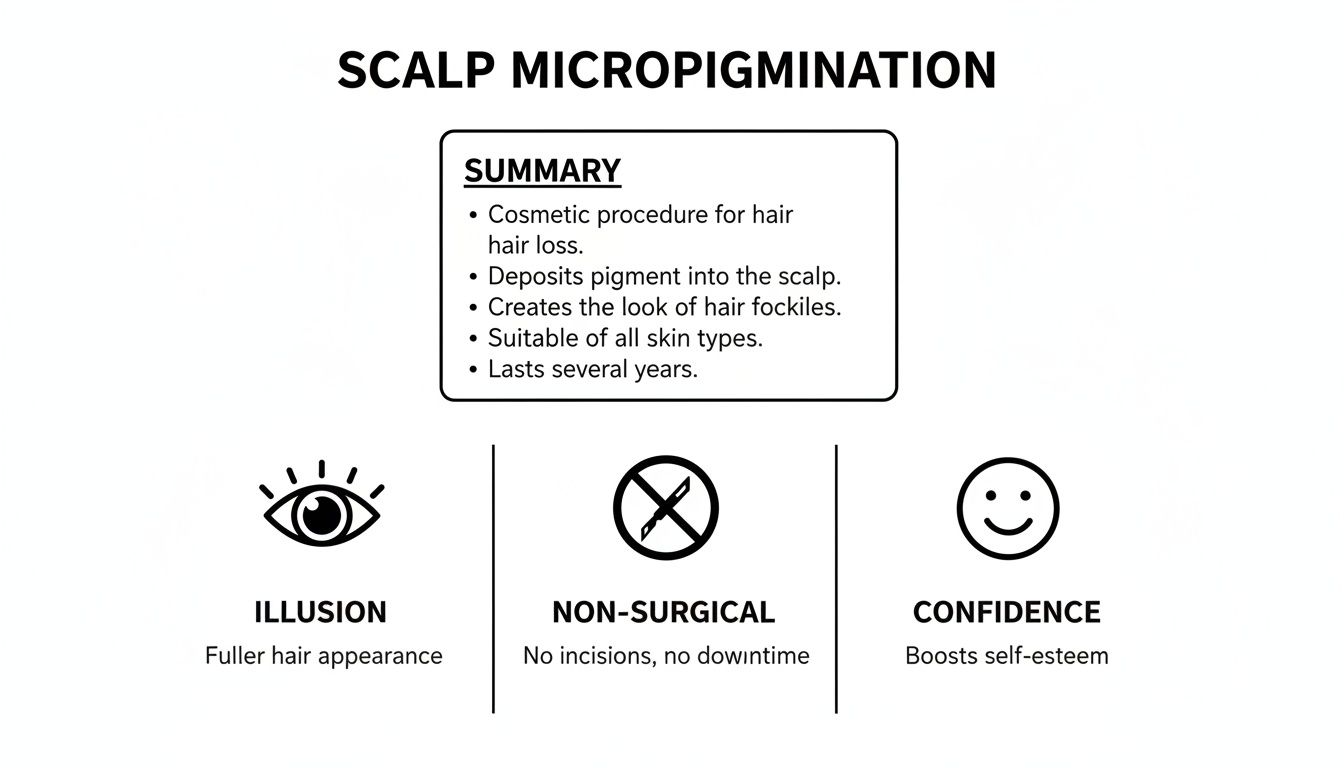
The key thing to remember is that SMP offers a guaranteed aesthetic result, making it an incredibly reliable choice for restoring the look of a full head of hair. And for those interested in supporting their hair health naturally, looking into things like Camellia oil for hair growth can also provide some great tips.
When you lay out the facts, SMP stands out as a powerful, non-invasive alternative. It delivers immediate visual results without the waiting game or uncertainty that comes with other methods.
Ultimately, the best choice is a personal one. It depends on your specific pattern of hair loss, your budget, and your long-term goals. For a much deeper dive, you might find our guide on how SMP compares to other hair restoration methods helpful.
Everyday Styling Tips to Maximise Hair Fullness
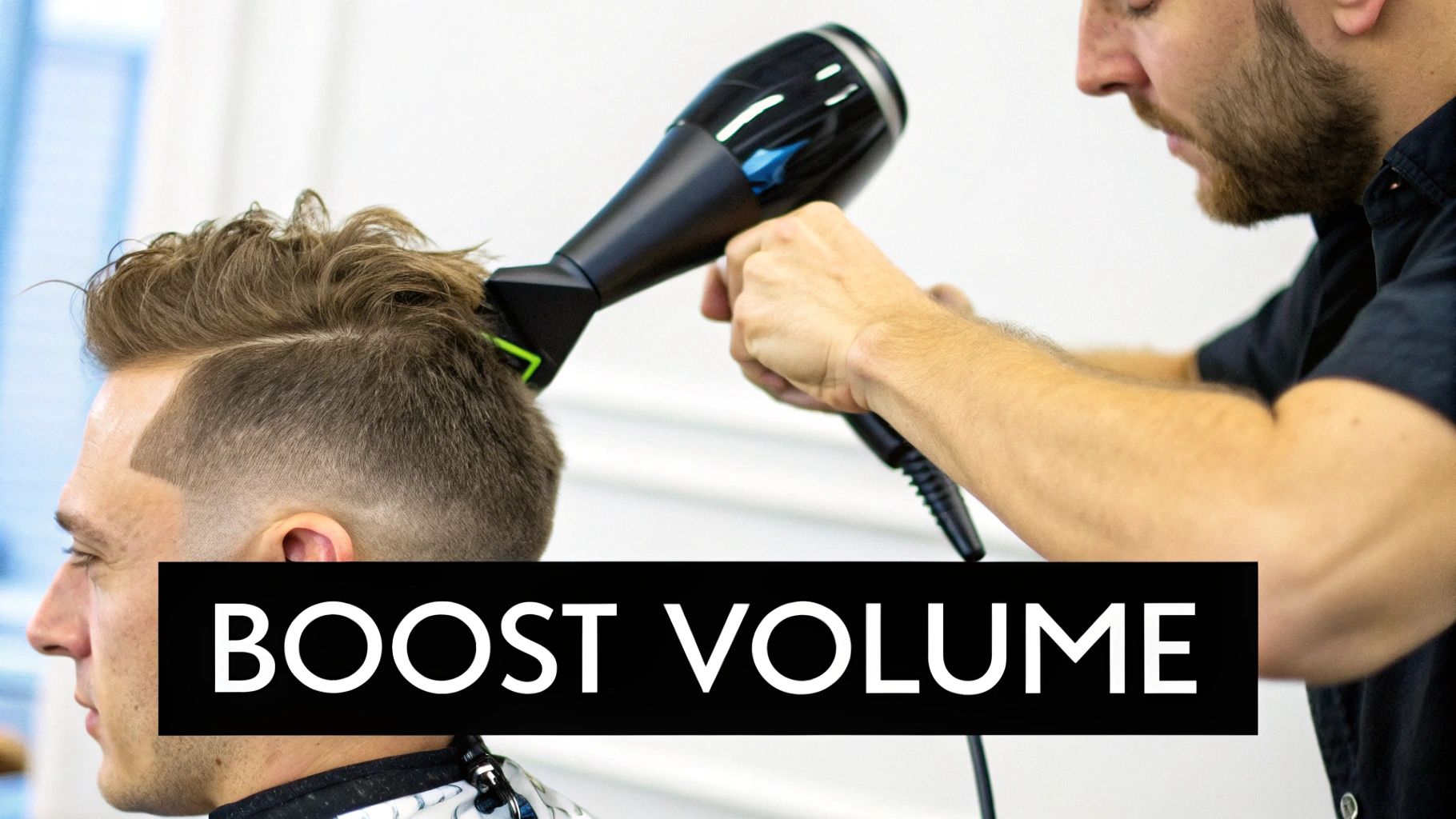
While you're weighing up long-term solutions, what you do day-to-day can make a massive difference to how you feel. The right styling approach creates a powerful illusion of fullness, giving you an immediate confidence boost. And it all starts with a solid foundation: a great haircut.
A strategic cut builds shape and volume right where you need it. For guys with shorter hair, a textured crop works wonders. It creates movement and breaks up solid lines, which helps to make the scalp far less visible. If you've got longer hair, layered cuts are fantastic for removing dead weight from the ends, giving the hair at your roots more lift and bounce.
Choosing the Right Products for Volume
The products in your cabinet are just as crucial as the cut itself. The name of the game is adding body without weighing your hair down—a common trap with heavy creams and oils. Your daily routine should be built around lightweight, volumising formulas.
First up, get yourself a good volumising shampoo and conditioner. They're specifically made to clean your hair without leaving behind heavy residues that just flatten everything out. When it comes to styling, a bit of volumising mousse worked into damp roots before blow-drying can give you some serious, all-day lift.
To put the finishing touches on your style, a light mist of texturising spray adds a bit of grit and separation, which makes each strand of hair look thicker and fuller.
The key is to steer clear of products loaded with heavy silicones or oils. They tend to coat fine hair, which can make low-density areas look even more noticeable. Always hunt for formulas described as "lightweight," "volumising," or "thickening."
Smart Styling Techniques
Even how you dry your hair can completely transform its look. One of the easiest and most effective tricks in the book is to blow-dry your hair upside down. This simple move lifts the roots directly away from your scalp, creating natural-looking volume from the base.
Another brilliant tool to have in your arsenal is dry shampoo. Even on clean hair, a quick blast at the roots soaks up any scalp oils that might be weighing things down. Plus, its powdery texture gives you instant grit and lift. It's the perfect trick for a midday volume boost.
For a quick-fix cover-up, especially around a wider part line or a thinning crown, temporary root cover-up powders or hair fibres are your secret weapon. Honestly, these products are game-changers for instantly camouflaging scalp show-through.
- Root Cover-Up Powders: These are basically tinted powders you brush onto the scalp. They match your hair colour and instantly make any thinning spots less obvious.
- Hair Fibres: These are tiny, statically charged keratin fibres that you sprinkle onto your hair. They grab onto your existing hair, making each individual strand look much thicker and fuller.
These cosmetic tricks offer an immediate boost and are the perfect sidekick to any long-term treatment plan you're thinking about. They put you back in control of how your hair looks on any given day.
It’s Time to Take the Next Step
You’ve now got a solid understanding of what low density hair is, its causes, and how to spot it. More importantly, you know there are powerful, modern solutions available to bring back that look of fullness. Knowledge is a great starting point, but taking action is what really brings back your confidence.
The main thing to remember is that you don't have to just live with thinning hair. There are effective, reliable options right here in Perth to help you feel like yourself again. Letting thinning hair dictate how you feel every single day is a heavy burden, but it’s one you can choose to put down.
Your Path is Unique, Your Plan Should Be Too
Everyone’s journey with hair loss is different. The specific pattern of your thinning, your hair type, and what you want to achieve all come into play. This is exactly why a one-size-fits-all approach just doesn’t work.
The best way forward is with a private, one-on-one consultation. It’s a chance to talk openly about your concerns in a comfortable and professional space, with no pressure or obligation. Think of it less as a sales pitch and more as a dedicated strategy session to give you real answers and a clear plan.
During your assessment, we will:
- Carry out a professional evaluation of your current hair density.
- Talk through the specific results you're hoping for.
- Answer all your questions about solutions like Scalp Micropigmentation.
- Walk you through the entire process, from start to finish, so you know exactly what to expect.
Taking control begins with a simple conversation. The goal is to move you from a place of frustration and uncertainty to one of genuine confidence, armed with a clear strategy made just for you.
Reclaim Your Confidence, Starting Today
Stop wasting energy trying to hide thinning spots or feeling self-conscious every time you're under bright lights. A real solution can help you get back the confidence you’ve been missing, so you can focus on the things in life that truly matter.
That first step is always the hardest, but it's also the most rewarding. Just imagine looking in the mirror and seeing a fuller, denser-looking head of hair, without the daily stress and worry. That reality is much closer than you might think. It’s time to stop wondering and start doing something about it.
Ready to explore your options with an expert who gets it? Book your free, confidential consultation with My Transformation today and discover how a personalised hair loss solution can restore your confidence. Learn more and schedule your appointment at https://www.mytransformation.com.au.