
Your Guide to FUE Hair Transplant Costs and Results
So, what exactly is a FUE hair transplant? At its heart, it's a remarkably precise and minimally invasive procedure. We take individual hair follicles, one by one, from a part of your scalp where hair is dense and healthy (usually the back and sides) and then carefully implant them into the areas where you're experiencing thinning or balding.
The real magic of this technique lies in its ability to deliver exceptionally natural-looking results, without leaving behind the long, linear scar that was the hallmark of older hair transplant methods.
How the FUE Hair Transplant Method Actually Works
Think of it like an expert gardener meticulously moving the healthiest seedlings from a thriving patch of lawn to a sparser area. The goal is to ensure each one is perfectly placed to take root and flourish. That's essentially what we're doing with a Follicular Unit Extraction (FUE) hair transplant. We're not moving strips of skin; we're relocating individual follicular units—the natural clusters of one to four hairs that grow together.
This follicle-by-follicle approach is what makes FUE so different. By harvesting grafts one at a time, the surgeon can hand-pick the strongest, most viable follicles for the transplant. This level of precision is an art form, allowing us to recreate the soft, slightly irregular pattern of a truly natural hairline. The final result is something that blends seamlessly with your existing hair.
The New Gold Standard in Hair Restoration
The procedure itself is performed with a specialised micro-punch tool, which is typically less than a millimetre in diameter. This tiny instrument is used to isolate and extract each follicular unit, leaving behind nothing more than minuscule, pinprick-sized marks in the donor area. These heal up incredibly quickly and become practically invisible once the surrounding hair grows back in a little.
It’s this specific benefit—the lack of noticeable scarring—that has cemented FUE as the go-to choice for anyone looking for a powerful hair restoration solution with minimal downtime.
A FUE hair transplant is a permanent fix for hair loss. The transplanted follicles are taken from areas of the scalp that are genetically resistant to balding, so they'll keep growing for the rest of your life in their new spot, giving you a lasting result you can feel good about.
Here in Australia, and particularly in Western Australia, FUE has really taken off since about 2017. It quickly became the leading method for both men and women tackling hair loss, overtaking the more traditional techniques. Why? Because it leaves only tiny, scattered dot scars that are hard to spot even if you like to wear your hair short—perfect for the active Aussie lifestyle. You can read more about the rise of FUE in Australia on pilot.com.au.
This advanced technique is about more than just restoring hair; it’s about restoring confidence. Its popularity is driven by some significant advantages:
- No Linear Scar: This is a big one. Unlike older methods, FUE doesn't leave a long scar across the back of the head, so you have the freedom to cut your hair short without a second thought.
- Quicker Recovery: With no stitches to worry about, the healing process is generally much faster and more comfortable for most people.
- Authentic, Natural Results: The ability to place each follicle with precision means your surgeon can design a soft, natural-looking hairline that truly looks like your own.
A Step-by-Step Look at the FUE Hair Transplant Procedure
Knowing what to expect on the day of your FUE hair transplant can take a lot of the mystery—and anxiety—out of the process. It's not a major, intimidating surgery. Instead, think of it as a day dedicated to a series of precise, carefully managed steps, all designed to keep you comfortable while delivering the best possible results.
So, let's walk through what the day actually looks like from start to finish.
First up is preparing the donor area. This is almost always the back and sides of your head, where the hair is genetically programmed to resist balding and tends to be thickest. Your surgeon will trim this section down to get a clear view of every single hair follicle, which is crucial for a precise extraction.
Next, a local anaesthetic is applied to numb both the donor area and the recipient area (where the hair will be placed). This is a game-changer, as it makes the entire procedure virtually painless. You'll be awake and comfortable the whole time, free to listen to music, watch a movie, or just relax while the team works their magic.
Phase 1: Extracting the Donor Follicles
This is where the 'Extraction' in Follicular Unit Extraction comes into play. Using a specialised micro-punch tool, often less than a millimetre wide, the surgeon carefully isolates and removes individual follicular units. A follicular unit isn't just one hair; it's a naturally occurring group of 1 to 4 hairs.
The best analogy is a master jeweller meticulously selecting individual gems. Each follicular unit is chosen for its health and strength to give it the best possible chance of thriving in its new home. This painstaking, one-by-one method is what defines FUE and, importantly, prevents the linear scar left by older techniques. The harvested follicles are then placed in a special holding solution to keep them perfectly preserved for the next stage.
This diagram shows the basic idea: moving individual follicles from a dense area to a thinning one.
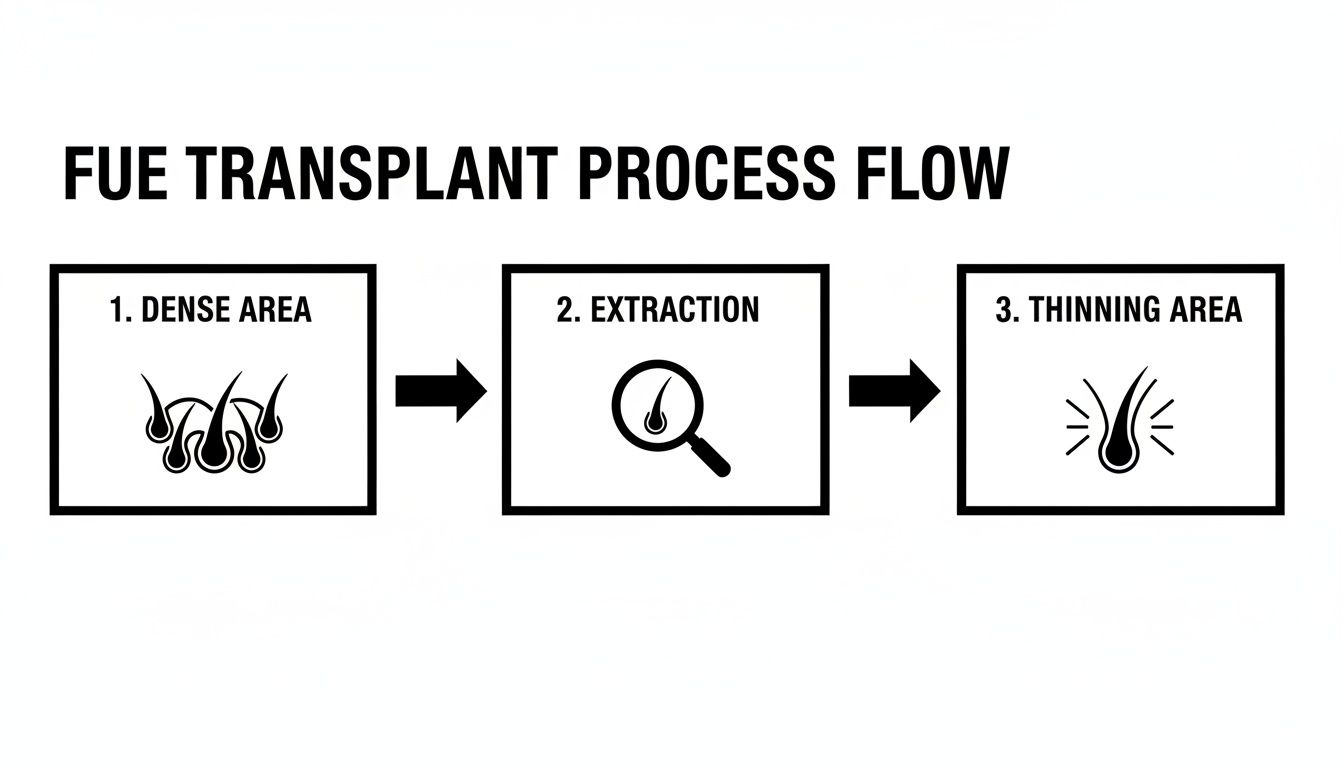
As you can see, it’s all about precision—taking hair from where you have plenty and strategically relocating it to build natural-looking fullness.
Phase 2: Creating the Recipient Sites
With enough healthy follicles harvested, the team’s focus shifts to the area getting the new hair. This is where the procedure becomes as much an art as it is a science. The surgeon makes tiny incisions, called recipient sites, across the balding or thinning parts of your scalp.
This isn't just random dotting. Every single incision is strategically made to mimic your natural hair growth, matching the exact angle, direction, and density of the hair that used to be there.
The real artistry of a FUE hair transplant shines through in this phase. A truly great result is defined by a soft, irregular hairline that looks completely natural—not like a row of doll's hair. This is the skill that separates a decent outcome from an incredible one.
A seasoned surgeon will place single-hair grafts right at the front to create a soft, feathered hairline, then use the larger, multi-hair grafts behind them to build up density and volume.
Phase 3: Placing the Grafts
The final phase is the meticulous work of implanting the harvested follicular units into the new recipient sites. Working with high-powered magnification, the surgical team places each graft, one by one. It’s a delicate, time-consuming process that demands incredible focus.
The team ensures every graft is seated perfectly at the correct depth and angle to heal properly and grow successfully. The total number of grafts can be anywhere from a few hundred to several thousand, all depending on your level of hair loss and what you’re hoping to achieve. For instance, filling in the temples might take 500-1,500 grafts, while restoring a larger area on the crown could require 2,500 grafts or more.
Once the last graft is in place, you’re all done. The clinic will give you a detailed aftercare kit and instructions to protect your new follicles and set you up for a smooth recovery. You head home the very same day, ready for the healing process that will lead to your final, permanent results.
Is FUE Hair Transplant the Right Choice for You?
A great result from a FUE hair transplant isn't just about the surgeon's skill—it really starts with whether you're a good fit for the procedure in the first place. Not everyone experiencing hair loss is an ideal candidate, so understanding what surgeons in Western Australia look for is your first and most important step.
The biggest factor is why you're losing your hair. FUE is most effective for people with androgenetic alopecia, which you probably know as male or female pattern baldness. This type of hair loss follows a predictable pattern and leaves a stable 'donor area' at the back and sides of your head, where the hair follicles are genetically built to resist balding.
On the other hand, if your hair loss is due to a medical condition, a specific medication, or even stress (like telogen effluvium), a transplant might not be the answer. The whole idea is to move healthy, permanent hair, so your existing hair loss needs to be stable.
Your Candidacy Checklist
So, what exactly does a surgeon look for during a consultation? They’re essentially running through a mental checklist to make sure you have the highest possible chance of a successful, long-lasting result.
Here's what they'll be assessing:
- Donor Area Density: It all comes down to supply and demand. The success of your FUE procedure depends entirely on having enough healthy hair follicles in your donor area. If that area is already thin, there simply won't be enough grafts to create the coverage you want.
- Hair Loss Stability: The best candidates are those whose hair loss has either stopped or is progressing very slowly. If you get a transplant too early, while your hair loss is still aggressive, you can end up with an unnatural look as the surrounding native hair continues to thin out.
- Your Overall Health: Like any surgical procedure, being in good general health is key for a smooth recovery. It’s vital to be upfront about any medical conditions or medications you’re on during your consultation.
- Realistic Expectations: This one is huge. A FUE transplant can deliver incredible, natural-looking results, but it can't magically give you the hair of a teenager if your donor supply is limited. Understanding what the procedure can and can’t do is fundamental to being happy with the outcome.
Age and Scalp Health Considerations
While there's no official "best" age for a hair transplant, surgeons are generally cautious with younger patients, especially those in their early 20s. The main reason is that their pattern of hair loss might not be fully established yet, which makes it tough to design a transplant that will still look good years down the road.
Your scalp's health is another piece of the puzzle. The skin in both the donor and recipient areas needs to be healthy, without any inflammation or active skin conditions. A healthy scalp is the best possible foundation for the newly implanted grafts to heal and grow properly. To get a better handle on all the options available, it's worth exploring the different hair loss solutions for men out there.
The ultimate goal is to create a result that not only looks great today but continues to look natural and balanced for decades to come. This long-term vision is why a thorough candidacy assessment is so important.
By working through these factors with your surgeon, you can make a properly informed decision on whether a FUE hair transplant is the right move for you, setting yourself up for a successful and genuinely life-changing result.
Navigating the Recovery and What to Expect
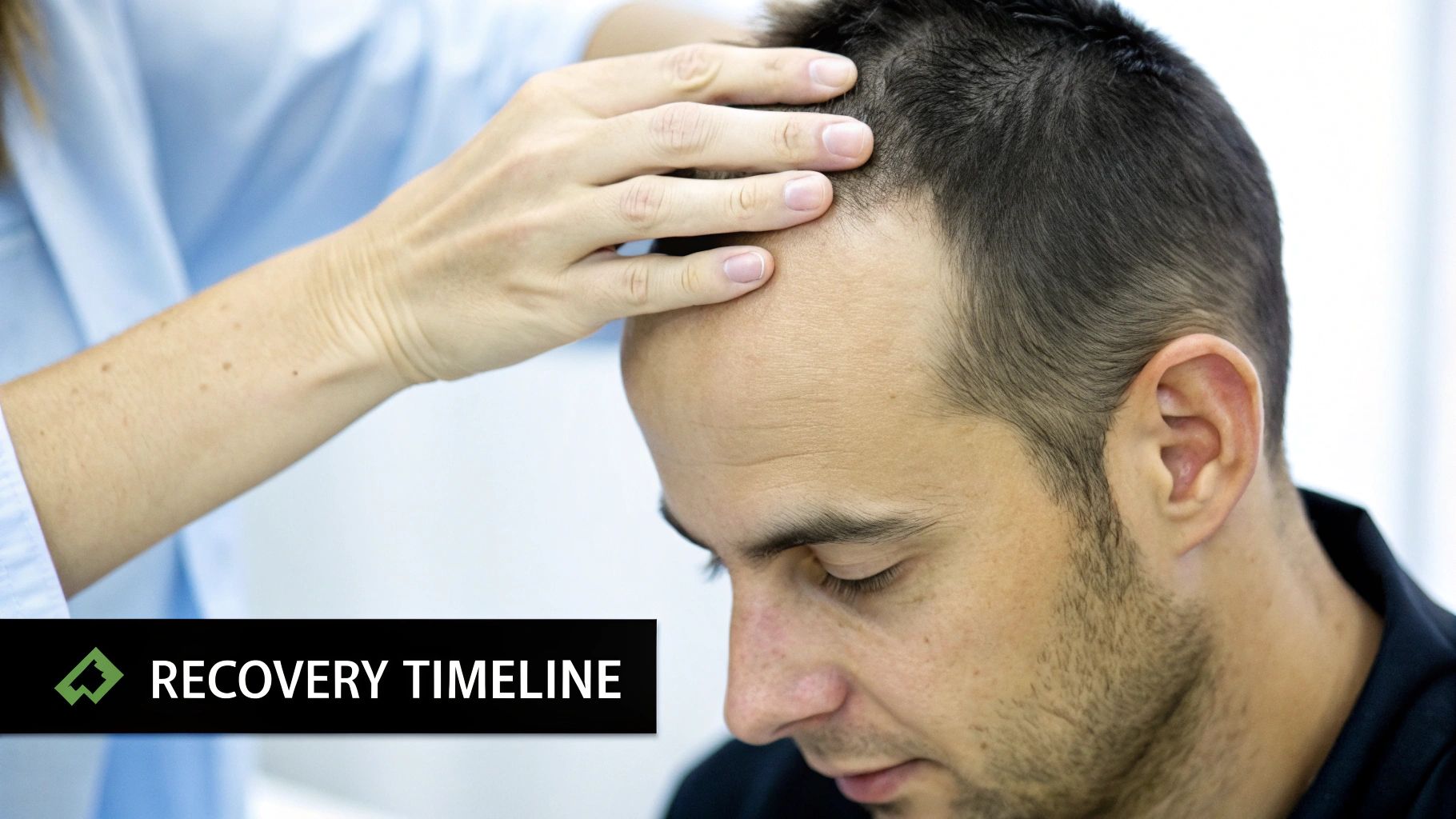
The day of your FUE hair transplant is a huge milestone, but the journey to a fuller head of hair really gets going once you leave the clinic. Understanding the recovery timeline is crucial for managing your expectations and making sure you get the fantastic results you’ve invested in. It’s more of a marathon than a sprint, with distinct phases every patient goes through.
For the first few days, it's all about healing. Your scalp will probably feel a bit tender, with some redness and mild swelling where the work was done. This is a completely normal part of your body's healing process. Your only job during this time is to be gentle and follow your clinic's aftercare instructions to the letter.
The First Two Weeks: Immediate Aftercare
This initial period is absolutely critical for the survival of your new grafts. The tiny transplanted follicles are incredibly delicate as they work to establish a new blood supply, so protecting them is your number one priority.
You'll get specific instructions on how to sleep (usually with your head elevated) and how to gently wash your scalp to keep it clean without accidentally dislodging anything.
- Week One: You’ll notice tiny scabs forming around each implanted follicle. It is vital that you do not pick or scratch them. They'll fall off on their own in about 7 to 10 days.
- Returning to Routine: Most people feel ready to return to a desk job and light activities within a few days. However, you'll need to steer clear of strenuous exercise, swimming, and prolonged sun exposure for at least a couple of weeks to prevent sweating and any risk of infection.
The Shedding Phase: What to Expect
Somewhere between two and four weeks after your procedure, something happens that often catches patients by surprise: the transplanted hairs start to fall out. This is known as the "shedding phase" or "shock loss." While it can feel a bit alarming, it's a perfectly normal and expected part of the hair growth cycle.
Think of it this way: the follicle, which is the tiny hair-producing factory, is safe and sound beneath the skin. The stress of the procedure simply causes the old hair shaft to be shed, making way for a new, stronger hair to grow in its place.
This shedding phase isn’t a sign that something has gone wrong; it’s a clear indication that the transplanted follicles are settling in and getting ready for a new cycle of growth. Patience is everything at this stage.
Long-Term Growth: The Final Results Timeline
After the initial shed, the real magic starts to happen, though it's a gradual process. The journey to your final result unfolds slowly and steadily over the course of a year or even longer.
- Months 3-4: You’ll begin to see the very first signs of new, fine hairs pushing through the scalp. They might look thin and sparse at first, but this is the exciting start of your new growth.
- Months 6-9: During this period, the growth becomes much more noticeable. The new hairs will start to thicken and lengthen, adding to your overall density. You'll get a much clearer picture of the final outcome.
- Months 12-18: By the one-year mark, most patients are seeing about 80-90% of the final result. Your hair will continue to mature, thicken, and improve in texture for up to 18 months. This is when you can truly appreciate the full, natural-looking success of your FUE transplant.
Success rates in Australia are exceptionally high, with expert clinics achieving up to a 97% graft survival rate—a huge leap from older methods. In cities where "FUE hair transplant" is a popular search, this is the natural regrowth timeline patients can expect to see play out over those 12-18 months.
For a more detailed breakdown of each healing stage, check out our complete guide on hair transplant recovery.
Understanding FUE Hair Transplant Costs in Australia
Let's get straight to the point: what’s the investment for an FUE hair transplant? It's the first question on everyone's mind, and the answer isn't a simple one-size-fits-all number. Think of it less like an off-the-shelf product and more like a completely custom-built solution for your hair loss.
The biggest factor influencing the price tag is the number of grafts you’ll need. A graft isn't just one hair; it's a tiny follicular unit that can contain anywhere from one to four hairs. So, if you're just looking to sharpen up your hairline, you'll need far fewer grafts than someone wanting to restore significant density across their crown.
Ultimately, the total cost directly mirrors the extent of your hair loss and what you want to achieve aesthetically.
Key Factors That Influence Your Quote
While the graft count sets the baseline, a few other crucial elements shape the final quote. These aren't just add-ons; they reflect the quality and expertise you're paying for to get a natural, lasting result.
- Surgeon's Expertise and Reputation: An experienced surgeon with a portfolio of fantastic, natural-looking results will understandably charge more. You’re not just paying for a procedure; you're investing in their skill, artistry, and years of experience.
- Clinic's Technology and Staff: State-of-the-art clinics using the latest FUE tools and supported by a highly trained team of technicians deliver a higher standard of care, and this is reflected in the price.
- Geographic Location: Just like with most services, the cost of running a premium clinic in major cities across Western Australia can affect the overall price compared to clinics in other areas.
- Complexity of Your Case: Every head of hair is different. Things like working with very fine or curly hair, or even correcting a subpar transplant from another clinic, demand more time and precision, which can influence the cost.
Financing and Payment Options
We get it—a FUE hair transplant is a significant financial decision, but it's also a life-changing investment in yourself. To make it more manageable, many Australian clinics now offer flexible payment solutions.
Think of the cost not as an expense, but as a long-term investment in a permanent solution. Unlike temporary fixes, the results of a FUE transplant are for life, providing lasting value.
Most top clinics will have options like interest-free payment plans or partnerships with specialised medical finance companies. It's always a good idea to bring this up during your consultation to find a plan that works for your budget. For a more detailed breakdown, check out our guide on hair transplant costs.
The FUE market in Australia is booming, and for good reason. It’s seen as the gold standard worldwide due to its minimally invasive approach. The market is projected to soar from AU$2,242.6 million in 2018 to AU$29,715.2 million by 2032. This incredible growth is fuelled by high demand for Aussie surgeons' expertise and the procedure's outstanding effectiveness—especially in our sunny climate where shorter hairstyles are so popular. You can read more about these hair transplant statistics on medihair.com. This trend really underscores the recognised value and success of the FUE technique.
Comparing FUE with Other Hair Loss Solutions
Once you decide to tackle hair loss, you’ll find a few different paths you can take. While a FUE hair transplant is a fantastic solution for many, it’s not the only one. Understanding how it compares to the alternatives is crucial for making a choice that truly fits your goals, lifestyle, and what you’re comfortable with.
The biggest head-to-head comparison in the surgical world is between FUE and the classic Follicular Unit Transplantation (FUT), which most people know as the "strip method." They both aim for the same result—more hair—but the journey to get there is quite different.
FUE vs FUT: The Surgical Showdown
The real difference between FUE and FUT boils down to one thing: how the donor hair is collected.
With FUT, the surgeon removes a thin strip of hair-bearing scalp from the back of your head. That strip is then carefully dissected under a microscope to separate out the individual hair follicles, which are then prepped for implantation.
This method works, but it has one major drawback: it leaves a long, linear scar. Sure, it’s usually hidden if you wear your hair longer, but for anyone who likes a short back and sides, that scar can be a deal-breaker. The recovery for FUT can also be a bit more intense, with stitches and a longer period of discomfort.
FUE, on the other hand, sidesteps the linear scar entirely. By extracting follicles one by one, it leaves only tiny, dot-like marks that are practically invisible once the hair grows back in a little. This is why FUE has become the go-to for people who want minimal scarring and a quicker, less invasive recovery.
The choice between FUE and FUT often comes down to one simple question: Do you want the freedom to wear your hair at any length without worrying about a visible scar? For most, the answer makes FUE the clear winner.
FUE vs Scalp Micropigmentation: A Non-Surgical Alternative
Surgery isn't for everyone, and sometimes it's not even necessary. That's where clever non-surgical options like Scalp Micropigmentation (SMP) enter the picture. SMP isn't a hair transplant at all; it's a highly specialised cosmetic tattoo designed to create the illusion of hair.
Think of it like artistic stippling for your scalp. A skilled practitioner uses micro-needles to deposit tiny dots of pigment, perfectly mimicking the look of real hair follicles.
This technique is surprisingly versatile and offers some unique advantages:
- Instant Results: A transplant takes months for the new hair to grow in. With SMP, you see the improvement straight away.
- No Donor Hair Needed: It's an excellent choice for those who might not have enough healthy donor hair to be a good transplant candidate.
- Creates Visual Density: SMP is fantastic for camouflaging thinning areas, making your existing hair appear much thicker and fuller.
Of course, the key difference is that SMP doesn't grow. It’s a 2D effect. A FUE hair transplant gives you real, living hair that you can cut, style, and run your fingers through.
Interestingly, the best result often comes from combining the two. You could use FUE to rebuild a natural hairline and then add SMP later to create an underlying shadow of density. You can learn more about how SMP compares to other hair restoration methods to see if it's right for you.
To help you get a clear picture, here’s a quick breakdown of how these three popular treatments stack up.
Comparing Hair Loss Treatment Options
| Feature | FUE Transplant | FUT (Strip) Transplant | Scalp Micropigmentation (SMP) |
|---|---|---|---|
| Procedure Type | Minimally invasive surgery | Invasive surgery | Non-surgical cosmetic tattoo |
| Result | Real, growing hair | Real, growing hair | Illusion of a shaved head or density |
| Scarring | Tiny, virtually invisible dot scars | Single long, linear scar in donor area | None (pigment, not scarring) |
| Recovery Time | Shorter (around 7-10 days) | Longer (2-3 weeks, with stitches) | Minimal (1-2 days of redness) |
| Best For | Receding hairlines, moderate balding, minimal scarring preference | Larger areas of baldness, patients who wear their hair long | Creating density, buzz-cut look, non-surgical candidates |
| Pain Level | Low discomfort post-op | Moderate discomfort, tightness | Minimal, topical anaesthetic used |
This table gives you a snapshot, but the best choice always depends on your individual situation. Exploring the full spectrum of effective hair loss solutions, from medical treatments to surgical procedures, will help you make a truly confident decision on your journey to hair restoration.
Your FUE Hair Transplant Questions Answered
Even with all the details covered, you probably still have a few questions buzzing around. That’s completely normal. Let's tackle some of the most common queries we get from clients, so you can move forward with total clarity.
A big one is always, "Will it hurt?" In short, no. The procedure itself is surprisingly comfortable. We use a local anaesthetic to completely numb your scalp, so while you might feel a little bit of pressure or a slight vibration from the tools, you won't feel any pain during the extraction or implantation.
Afterward, it's common to have some mild tenderness or a feeling of tightness for a few days. Think of it like a minor sunburn. This is easily managed with standard over-the-counter pain relievers and usually fades quickly as your scalp begins to heal.
Just How Permanent Are the Results?
This is the most important question, and the answer is one of FUE's biggest selling points: the results are permanent. The real genius of the procedure is where we source the hair from. The follicles on the back and sides of your head are naturally built to resist DHT, the hormone responsible for most male pattern baldness.
When we relocate these tough, DHT-resistant follicles to your thinning areas, they don't forget their genetic programming. They just keep on growing for life, exactly as they would have in their original spot. Your new, denser hairline isn't a temporary fix—it's there for good.
Will I Have Visible Scars?
One of the main reasons people choose FUE is because of how minimal the scarring is. It’s a world away from the old FUT "strip" method, which left a noticeable linear scar across the back of the head. FUE works differently. The micro-punch tool we use for extraction leaves tiny, pinprick-sized circular marks, each smaller than a millimetre.
These little dots are scattered across the entire donor area, so they don't create a single, obvious line.
Once the hair in your donor area grows back even a little, these tiny dot scars become virtually invisible. This is a huge confidence booster, giving you the freedom to wear your hair however you want, even a super short buzz cut, without a second thought.
For a more detailed look at what to expect, check out our guide to hair implant scars. It really breaks down the differences and helps set realistic expectations.
When Can I Get Back to Normal Life?
The recovery from an FUE hair transplant is surprisingly quick for most people. The first week or two are crucial for being gentle with the new grafts, but you'll be back to your usual routine before you know it.
Here’s a rough timeline:
- Desk Jobs: Most people feel comfortable returning to office-based work within 2-5 days.
- Light Exercise: You can get back to gentle activities like walking after about a week.
- Strenuous Activity: Hold off on heavy lifting, intense workouts, or anything that makes you sweat heavily for at least 14 days. This gives the new grafts the best chance to securely take root.
- Wearing a Hat: A loose-fitting hat can usually be worn after a few days, but it’s vital to get the green light from your surgeon first to avoid any rubbing.
It's all about protecting your investment in those first couple of weeks. A little patience goes a long way in ensuring every single graft thrives.
If you're ready to take the next step and explore how a permanent hair loss solution can restore your confidence, the team at My Transformation is here to help. We specialise in Scalp Micropigmentation, a fantastic option that can work alongside or as an alternative to a hair transplant. Contact us today for a consultation to discuss your unique needs.